Published on: June 29, 2026
China Just Wrote Rare Earths and Dual-Use Into Its June 22 Retaliation List — What Spot Buyers Should Actually Check Is Their Own BOM
On June 22 China's Commerce Ministry put 10 US firms on its export-control list and the Finance Ministry barred procurement from 46 more; a rare-earth miner and a magnet maker were named. For anyone trading spot chips and excess inventory, the real signal isn't the sanction — it's the words "dual-use" and "worldwide." Here's how to turn that into things you can do today.
Let's state the facts first.
On Monday, June 22, China's Commerce Ministry placed 10 US firms on its export-control list: rare-earth miner MP Materials, magnet maker USA Rare Earths, and a set of defense contractors in aerospace, drones, synthetic-aperture radar, and shipbuilding.
The same day, the Finance Ministry separately barred government procurement from 46 US firms, including subsidiaries of Lockheed Martin, Boeing, General Dynamics and General Atomics. US-funded but locally registered companies got an exemption.
The nature of it is clear: tit-for-tat. Two weeks earlier the Pentagon listed about 80 Chinese firms — Alibaba, Baidu and BYD among them — as "Chinese military companies." This is the return punch.
For most people this is a headline that scrolls past. For people who move parts, two words are worth stopping on.
Word one: dual-use
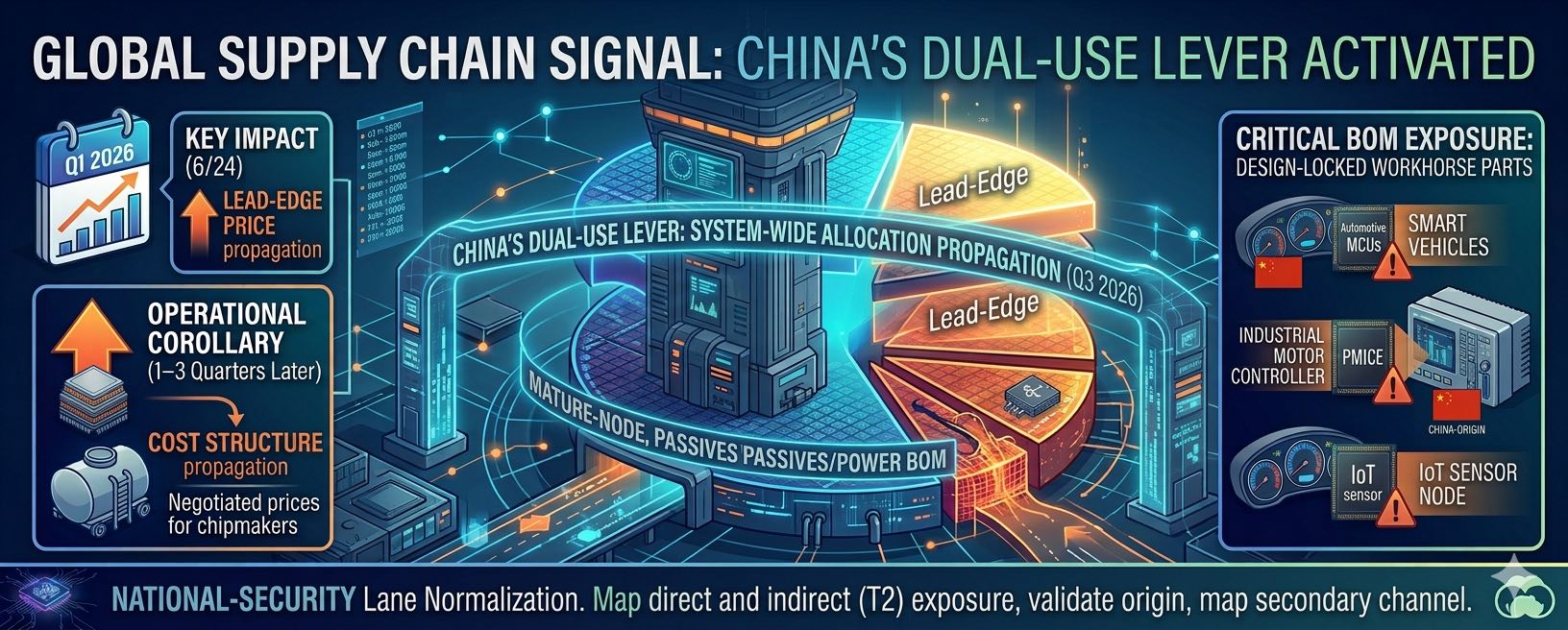
The Commerce order targets "dual-use" items — things usable for both civilian and military ends. The chip trade lives on that line every day. An industrial MCU, a high-spec ADC, an FPGA — by end-use, any of them can fall into the dual-use bucket. This order names 10 US firms, far from most spot business, but it confirms one thing: China is now actively using the dual-use lever, and it's drawn the language wide.
Word two: worldwide
The order contains a line — "institutions and individuals worldwide are prohibited from transferring Chinese dual-use items to the listed parties." That's extraterritorial reach. It means even if you're a broker in Hong Kong, Singapore or Dubai, moving China-origin dual-use parts, you're in scope in principle.
China essentially copied the logic of US semiconductor export controls. As Cameron Johnson of consultancy Tidal Wave Solutions put it bluntly: "They basically say it doesn't matter where or who you are, you are bound by this."
That's the part that touches you.
So what do you do now
One — pull your rare-earth-containing parts out first. Magnets, some inductors, speakers/buzzers, certain power devices and passives carry rare-earth content. Nobody's cut off today; the point is that forward-supply uncertainty on these now deserves its own line in your risk view.
Two — check the "origin + destination" of your channels. If you do transshipment or third-country brokering, the chain "China-origin dual-use part to a listed party," however unlikely, should be ruled out before you quote. Be especially careful on NCNR orders.
Three — dual-source the sensitive ones. For any single-source part that touches rare earths or dual-use status, start finding backups now — don't wait for the enforcement rules to drop.
Four — treat this as background, not panic. The experts agree (Nick Marro at EIU, Steve Okun in Singapore): this round is more symbolic than operational, hard to enforce — but "this is just the beginning." The May Trump-Xi summit eased tariffs; it did not ease the national-security lane. Both sides are still adding.
Five — watch magnet pricing. With rare earths named, the first thing to move isn't chips — it's magnets and magnet-bearing assemblies. If you also touch motor, sensor or actuator parts, keep an eye there.
One closing line, as judgment only
The list itself may get bypassed, exempted, or negotiated away soon enough. But "dual-use" and "extraterritorial reach" are tools that, once both sides start using them, don't get put back. This business used to compete on spread and speed. Going forward it competes on one more thing — whether you can say, clearly, where every part you touch came from and where it's going. That's not a compliance-department problem. It's the desk's problem.