Published on: July 22, 2026
HBM Is Eating DDR5's Wafers: Why Server Memory Stays Tight Into 2027 — and Consumer Price Cuts Don't Change That
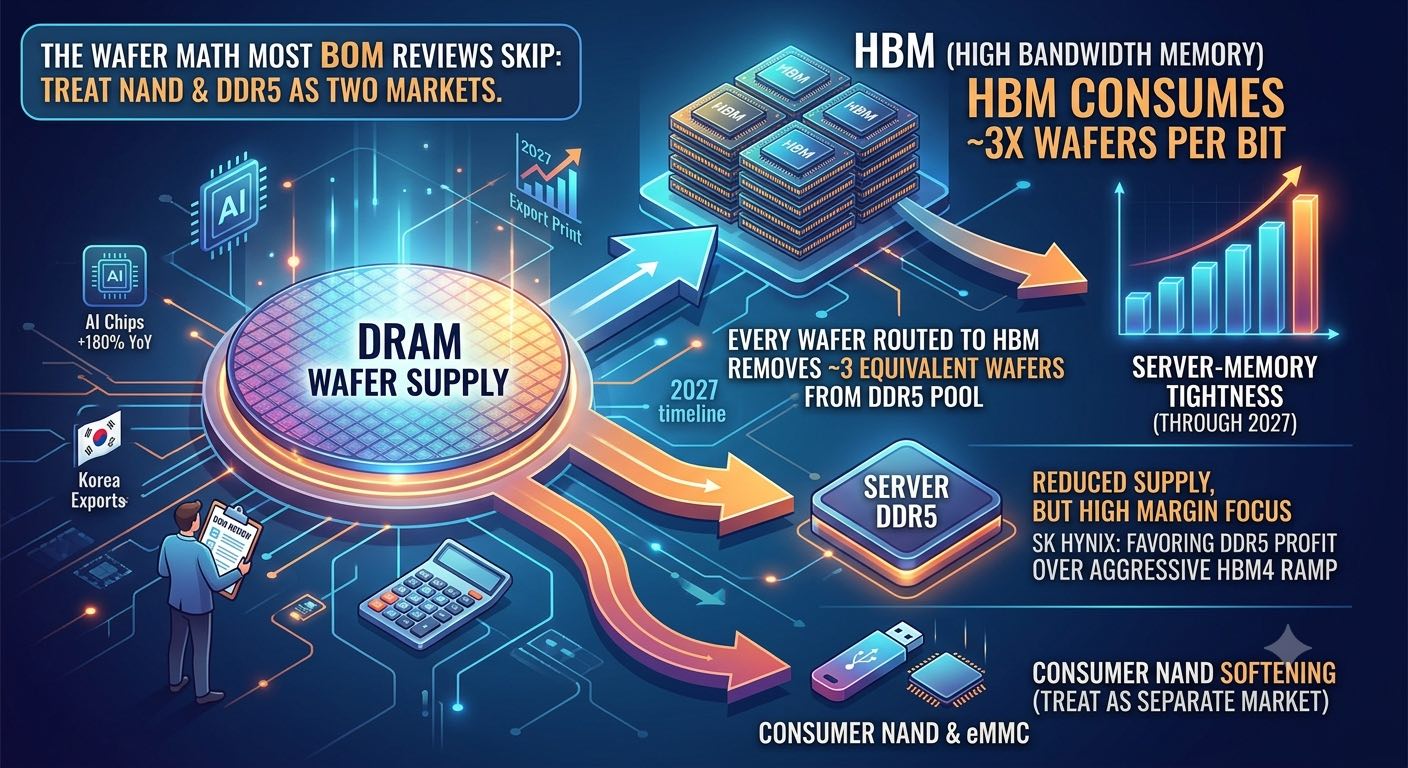
One sentence: every wafer that goes into HBM pulls roughly three out of the DDR5 line. Makers are openly prioritizing higher-margin DDR5 over the HBM4 ramp, so the server-DDR5 crunch isn't a cyclical wobble — it's a structural gap written into wafer allocation, holding until new capacity lands in H1 2027. Consumer NAND/eMMC is cooling, but that's a different book — don't let it discount your server parts.
The easiest trap for a spot buyer right now is reading "consumer memory is starting to come down" as "memory is loosening" — and then softening a server-DDR5 quote on the back of it. Those are two different books.
Start with this week's hard data. South Korea's first-20-days July exports rose 62.9% YoY on a working-day-adjusted basis — a record for any July — with AI-related chip exports up 180.6% YoY (Bloomberg, 07-21). That's customs data, not a stock note. The same day Micron ran +12%, SanDisk +14%, SMH +4% — the tape just caught up; what's actually moving is volume.
Here's why server DDR5 gets pinned on its own. Explain this cleanly and you can hold your price:
- HBM and DDR5 fight over the same DRAM wafers. The working number in the industry: every wafer put into HBM pulls roughly three out of the DDR5 line. HBM is bit-density-light and stacking-heavy (TSV / bonding), so it burns far more wafer per unit of shippable output. Every extra HBM stack the AI side demands is three DDR5 wafers the server side doesn't get.
- Makers are choosing this on purpose. SK hynix has been cited as "choosing DDR5 profits over the HBM4 ramp." When even the HBM leader finds DDR5 more profitable than chasing HBM4 right now, that tells you how firm the high-density DDR5 book is. Supply keeps tilting to margin — it isn't circling back for your spot order.
- New capacity is a 2027 story. Meaningful increments from hynix's M15X and Micron's Idaho fab are broadly pointed at H1 2027. This gap isn't "wait one quarter" — it's "wait until the middle of next year."
Now the contrast on consumer. NAND is stable relative to DRAM (Q3 contract calls range widely, 0 to +15%); consumer NAND/eMMC demand is softening and the price pass-through has topped. That book really is cooling — but it's cooling on its own, with zero bearing on the 64GB/128GB server RDIMM in your hand. Quote them together and a customer will use "NAND is down" to knife your DDR5.
Moves you can put to work today:
- Server DDR5 RDIMM and high-density modules: hold if you can carry, and cut quote validity to 24-48h — no one-week prices. Tonight's SK hynix Q2 print (07-22, post-market) recalibrates once more; wait for the HBM shipment guidance and DRAM ASP framing before you extend validity.
- Enterprise SSD is actually the shortest-lead major category (8-14 weeks). QLC is booked through 2026, but the constraint is allocation, not fab output — out-of-allocation spot leaves more room to quote than DDR5. List it proactively.
- Consumer NAND/eMMC dead stock: clear it into this server-driven strength while spot is still high. Don't hold it for a bounce — that book has already turned.
- When you build a customer BOM, split server DRAM and consumer storage into two price books with two validity windows. Don't let one "memory is falling" headline blur the two.
The closing read: this round of server-memory tightness isn't a demand-side impulse — it's a supply-side decision baked into wafer allocation. Anyone equating "HBM is hot, so all memory is tight" or "consumer is down, so all memory is loose" gets caught restocking on the back foot in H1 next year. There's only one variable worth watching: how many wafers the makers hand to HBM.