Published on: June 22, 2026
Enterprise SSD Is Draining the NAND Pool: How General-Purpose Parts, eMMC and UFS Get Pushed Into the Spot and Secondary Channel
Q1 enterprise SSD revenue hit a record $18.46B, up 86% QoQ, with contract prices up ~80% in a single quarter and supplier inventory at historic lows. AI is maxing out high-margin enterprise SSD capacity, dragging general NAND, eMMC and UFS up and out. Here's the practical read for spot buyers: what moves first, what to clear, what to stock.
The lead actor in this memory cycle just changed.
For months it was HBM, DRAM, the DDR4 inversion. The part actually draining the channel now is enterprise SSD.
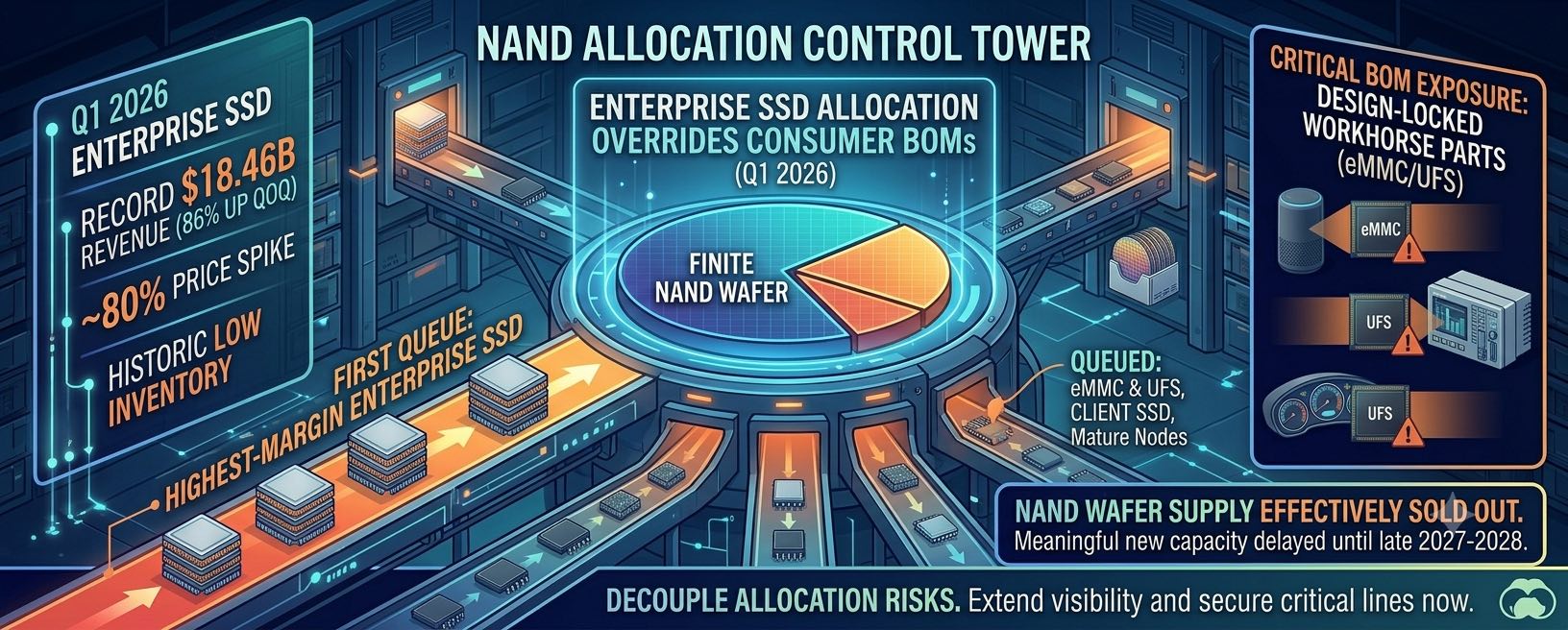
The numbers: Q1 global enterprise SSD revenue hit $18.46B, up 86% QoQ. Contract prices climbed roughly 80% in a single quarter. Supplier inventory is at historic lows.
The logic is simple. AI servers want high-capacity, high-performance enterprise drives. That's the highest-margin slot makers have, so wafers go there first.
Who gets pushed out? General-purpose NAND, client SSD, eMMC, UFS.
These parts aren't unwanted — they're at the back of the queue. Same production line, enterprise goes first, consumer gets whatever capacity is left. The result: general parts drift up, lead times stretch, and supply spills into the spot and secondary channel.
What's moving first
- Enterprise SSD (TLC / QLC, high capacity): tightest, contracts booked solid, almost no maker stock for spot buyers.
- Client SSD: dragging up, controller and NAND both tight.
- eMMC / UFS: used across consumer, industrial and automotive — high volume, hard to redesign out, the segment most worth watching.
- General NAND die: spot pricing being pulled upward.
Maker moves worth noting
- Kioxia's 218-layer NAND is ramping at North American customers; its 245TB QLC enterprise drive is in validation, with volume only in H2. Validation-phase capacity goes to top accounts first — secondary buyers can't jump the line.
- SanDisk / WDC's QLC enterprise SSD is in volume production, right into a high-capacity QLC shortage window.
- Solidigm is pushing 240-layer; SK Hynix is developing 375-layer TLC — all aimed at AI storage, leaving consumer parts further back.
Three moves for spot buyers
- If you're sitting on idle eMMC / UFS, list it now. General parts are dragging up, so the listing value of dead stock is amplified. Don't let it sit and depreciate — this is the exit window.
- For client SSD / eMMC / UFS your customers need, lock spot where you can, sign LTA or NCNR buffers where you can. Don't wait on maker scheduling — schedules only get longer.
- Track the SKU allocation cadence at Kioxia, SanDisk, Solidigm. Validation and ramp phases each open a gap window; whoever books first has the parts.
Mistakes to avoid
- Don't apply the DRAM playbook to NAND. DRAM is being drained by HBM; NAND is being drained by enterprise SSD — different transmission paths, same outcome for general parts: short, expensive, queued.
- Don't fixate on high-capacity enterprise drives. The margin for spot traders is in eMMC and UFS — high volume, fragmented end-markets, hard to substitute. You won't get the enterprise drives anyway.
This isn't a short-term wobble. NAND is effectively sold out for the year, and capacity additions wait until late 2027–2028. The squeeze on general parts holds through 2026 at minimum.
Whoever holds stock and locks parts early holds the cards this cycle.