Published on: July 27, 2026
$950B Just Locked Memory Capacity to 2030 — Three Things Spot Buyers Should Actually Do
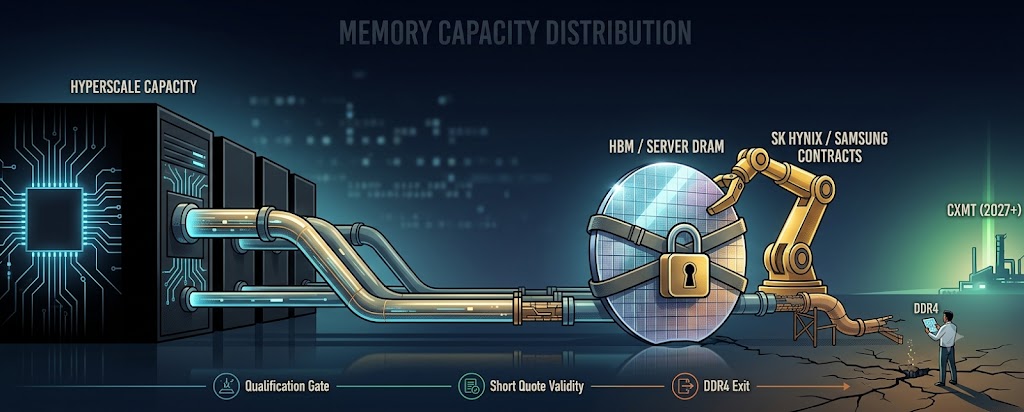
Over the weekend Korea announced ~$950B in SK Hynix + Samsung AI-chip supply pacts with US firms. This isn't a "they'll expand and cut prices" story — it's a supply-structure signal that hands leading HBM and server-DRAM capacity to hyperscalers under multi-year contracts. For spot and commercial buyers, marginal allocation only gets thinner. Here are three things you can act on this week.
The headline writers will call it "Korea lands $950B in deals." For anyone who actually moves parts, the size of the number is the least interesting thing about it.
Here's what happened. During President Lee's San Francisco visit (07-25/26), Korea's presidential office announced two commitments: SK Hynix will supply Nvidia and others with $750B of memory — HBM at the core — over five years, and Samsung signed a $200B MOU with Broadcom covering advanced memory and AI foundry. The room was Jensen Huang, Sam Altman, Dario Amodei, Hock Tan. Every one of them a hyperscale consumer of HBM and advanced packaging.
Thing one: this is capacity getting locked, not capacity getting added.
This is the read spot buyers get backwards most often. "Big maker signs big deal" reflexively reads as "supply is coming, prices ease." It's the opposite. These pacts mean the output of leading HBM and server DRAM is spoken for by a handful of hyperscale accounts for years. Makers were already choosing DDR5 margin over an HBM4 ramp — now that prioritization is written into contracts. Whatever marginal allocation was left for the merchant channel, spot, and commercial grades gets smaller, not larger.
If you're holding server DDR5 RDIMM, HBM-adjacent parts, or enterprise SSD, don't ease your quotes because "the maker signed a big deal and will ramp." The logic runs the other way.
Thing two: separate the demand anchor from the supply anchor — don't quote them together.
Two anchors this week point in opposite directions:
- Demand side: the $950B pacts are a state-level endorsement of the AI-memory super-cycle running to at least 2030.
- Supply side: CXMT lists on Shanghai's STAR Market today (07-27), raising ~RMB 57.9B in the largest STAR IPO ever, ~212x oversubscribed, with proceeds aimed at DRAM expansion.
Both are real, but they act on different clocks. The pacts tighten allocation now. CXMT's expansion is a 2027-and-beyond variable. Don't use "China is ramping" to beat down live pricing on leading server or auto parts today — that's fighting today's shortage with next year's supply, and the moment a customer pushes back you've lost the quote.
Thing three: yes, move on second-source — but move on the right tier.
CXMT's listing shows domestic DRAM now has the capital to keep expanding. That's a genuine signal. Split the action:
- Commercial / PC grades: add CXMT to the second-source watch list and start pulling qualification paperwork now. This is where the substitution window is genuinely opening.
- Leading server / automotive grades: nothing has loosened near-term. Don't wave domestic pricing around as a lever on leading quotes before qualification, lead time, and consistency are cleared.
To close.
There's one more hard anchor right behind this: SK Hynix Q2 earnings print Wednesday (07-29, Seoul AM). Watch HBM4 shipment guidance and the H2 HBM outlook. Hold DDR5 and server memory to 24-48h short quotes until it lands.
What the $950B number really tells you isn't "there's a lot of money." It's "who owns leading capacity for the next few years." The answer is: the hyperscalers. Spot buyers and middle-men sit further back in the allocation chain — and understanding that is worth more than remembering the number.