Published on: July 3, 2026
Meta Is Plugging Dead DDR4 Back Into Its Servers — and One Custom CXL Chip Just Rewrote What "Idle Memory" Is Worth
At ISCA 2026, Meta unveiled Vistara, a home-grown CXL ASIC that bolts obsolete DDR4-2400 onto DDR5-only servers. For anyone moving spot parts and clearing idle stock, this is a public ruling on whether old memory still has value.
Start with the facts.
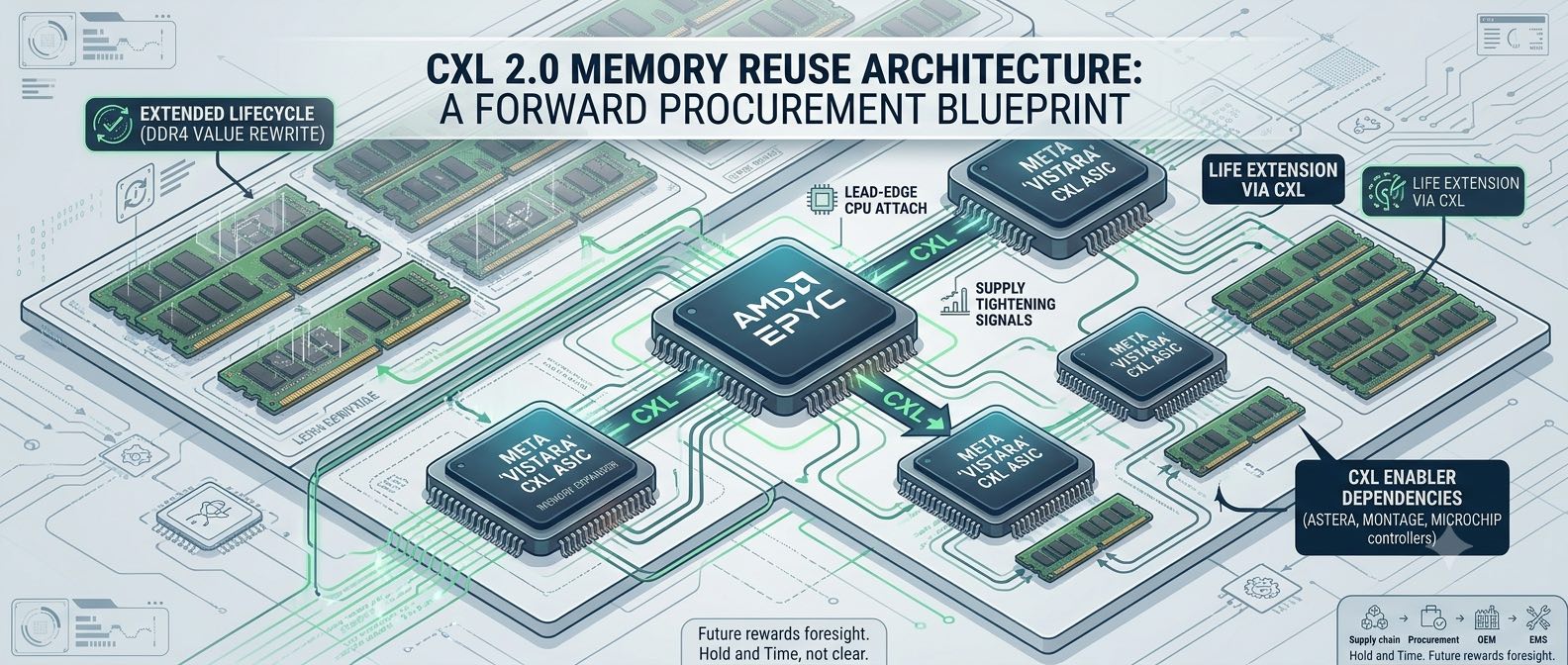
At ISCA 2026 (June 29–30), Meta disclosed a custom ASIC called Vistara. It's Meta's first-gen CXL 2.0 Type-3 memory expander, running over PCIe 5.0 x16, and it does exactly one thing: bridge standard DDR4-2400 RDIMMs to AMD EPYC "Turin" hosts that only support DDR5.
The config: 768 GB of local DDR5-6400 per server, plus 256 GB of CXL-attached DDR4-2400, for 1 TB total.
This isn't a lab demo. Meta calls it production-scale, deployed across millions of servers. For some disaggregated inference workloads, it cuts the required server count by up to 25%.
The motive, in one line: DDR5 is expensive, and Meta doesn't want to keep paying the memory tax.
On the surface this reads as "hyperscaler saves money." From a parts desk, three layers matter more.
Layer one: a giant buyer just put a price on old silicon, in public
DDR4 sits on a standard EOL path — the closer to end-of-life, the less it should be worth. Instead it's been running the other way for a year, with some configs up 50% quarter-on-quarter (that's background, not this week's news). Vistara stamps that anomaly with an official seal: a custom chip and millions of machines of engineering, purely to squeeze residual value out of memory that was supposed to be retired.
When a company that counts every dollar is willing to do that much engineering for old RAM, that decision is itself an appraisal of the DDR4 sitting in your bins.
Layer two, the counterintuitive one: secondary DDR4 may get tighter, not looser
What has the spot channel been feeding on? The DDR4 that hyperscalers dump when they decommission, retire, and clear out. Data-center refresh → old DDR4 flows into secondary → you and I catch it on the open market.
Meta's logic just flipped: don't dump it — re-attach it via CXL and keep using it. If that model gets copied across other hyperscalers, that "retire-into-secondary" river runs thinner.
The conclusion is awkward but real: a technology built to extend the life of old parts could, short-term, make secondary DDR4 harder to find. If you're holding DDR4-2400 / DDR4-3200 quantity, don't dump it on an EOL reflex.
Layer three: the CXL expander part itself starts to have a story
Vistara is Meta's own, but not everyone rolls their own. The merchant CXL Type-3 expander controllers — Astera Labs, Montage, Microchip's SMC — ride this same demand curve. Whoever's BOM starts carrying a CXL memory-expansion path becomes a buyer for that part. This isn't a call to stock it today; it's a call to put the family on your radar.
Three lines, in action terms
- DDR4 server memory in hand (RDIMM, 2400/3200) — don't clear it at an EOL discount. This news lifts the floor; sit on it and watch the tape.
- Track hyperscaler decommission cadence. If "keep and reuse" goes mainstream, secondary DDR4 tightens — buy quantity while it's still loose.
- Add CXL Type-3 expander controllers (Astera / Montage / Microchip) to your watchlist so you react when they surface in downstream BOMs.
A chip built to save money quietly redefined what "idle memory" means. For anyone who lives on the spread, a repricing moment is exactly when the position should move.