Published on: September 16, 2026
Micron 512GB DDR5 RDIMM Brings 9,200 MT/s and 12TB Dual-Socket Capacity Into Platform Validation
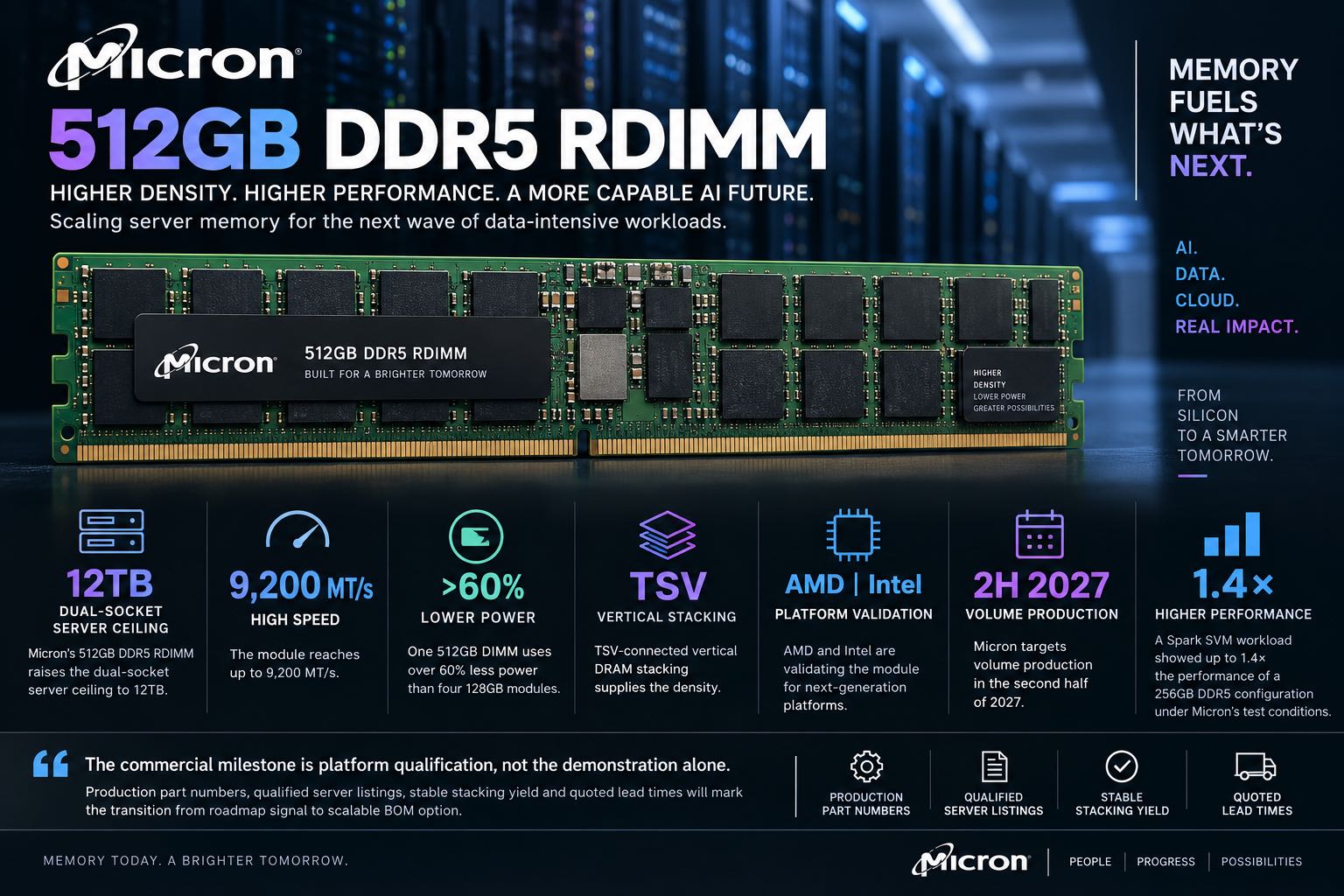
Micron demonstrated a 512GB DDR5 RDIMM supporting up to 9,200 MT/s and 12TB in a 24-slot dual-socket server. One module uses more than 60% less power than four 128GB modules. AMD and Intel validation is underway, with volume production targeted for the second half of 2027.
A 512GB module resets the server capacity boundary
Micron announced the demonstration on September 15, 2026. The 512GB DDR5 RDIMM reaches up to 9,200 MT/s, uses vertically stacked DRAM dies connected with through-silicon vias, and enables as much as 12TB in a 24-slot dual-socket server. AMD and Intel are validating the module. Micron expects volume production in the second half of 2027. The company states that one 512GB module uses 16.0W versus 44.2W for four 128GB modules, a reduction of more than 60%, and reports up to 1.4 times the performance of a 256GB DDR5 configuration in a Spark SVM analytics workload.
The capacity step is important because it changes the amount of data that can remain close to the processor. AI inference, real-time analytics, simulation, caching and in-memory databases all lose efficiency when working sets spill into slower storage tiers. A 12TB dual-socket configuration creates additional room for larger resident datasets, although the realized benefit depends on CPU memory controllers, firmware, NUMA placement and application behavior.
Density and power move together
The power comparison is unusually material. Micron lists 16.0W for one 512GB module and 44.2W for four 128GB modules providing the same nominal capacity. Fewer modules reduce slot consumption and may lower cooling and fan requirements at system level. The result can raise memory capacity per rack without increasing the number of servers, a useful attribute where power and floor space are binding constraints.
Micron also reports up to 1.4 times higher performance than a 256GB DDR5 configuration in a Spark SVM workload. That figure shows the potential cost of insufficient resident memory, but it is workload-specific supplier data. Database, cache, analytics and AI deployments need validation with production data, realistic concurrency and platform power limits before the figure becomes a planning assumption.
Platform validation is the commercial gate
AMD and Intel are validating the module for next-generation server platforms. This stage covers memory training, signal integrity, firmware behavior, reliability and serviceability. Combining 512GB density with speeds up to 9,200 MT/s raises both electrical and thermal design requirements. A successful demonstration therefore does not imply immediate broad availability.
The second half of 2027 is Micron's stated volume-production window. Procurement evidence will emerge through qualified vendor lists, production part numbers, supported speed bins, sample coverage, warranty specifications and quoted lead times. Until those items appear, the module is best treated as a roadmap signal rather than a near-term supply source.
Packaging becomes part of memory competition
The module uses vertically stacked DRAM dies linked with TSVs. That architecture increases the importance of stacking yield, thermal control, package test and final module validation. Value creation extends beyond the DRAM wafer into advanced packaging and platform co-engineering. Suppliers able to coordinate those stages can differentiate on deliverable capacity rather than raw die output alone.
The product does not establish a uniform shortage across DDR5. A 512GB server RDIMM has different die, package, rank and validation requirements from 128GB or 256GB modules, and it is not interchangeable with client-PC memory. Price and availability analysis must remain specific to density, speed, platform and qualification status.
The path to the 2027 production window
The most important milestones over the next year are validation and manufacturing execution. Timely AMD and Intel qualification would support OEM introduction and cloud evaluation. Stable stacking yield and thermal performance would then determine how quickly production volumes can scale. Delays in either layer would move deployment beyond the stated window.
For current procurement, existing 128GB and 256GB RDIMM lead times, allocations and contract prices remain the relevant evidence. For medium-term architecture, the simultaneous appearance of production part numbers, server qualification and OEM configuration listings would mark the transition from demonstration to a scalable BOM option. The announcement clearly raises the server-memory capacity ceiling, while its commercial effect remains tied to execution through the second half of 2027.
A practical qualification checklist
Four signals separate engineering progress from commercial availability. Production part numbers need density, rank, speed and thermal specifications. AMD and Intel platforms need qualified-memory listings that identify supported server generations and firmware requirements. System vendors need orderable configurations rather than demonstration systems. Quoted lead times and allocation terms then need to become visible through authorized channels. A gap at any stage can keep an otherwise functional module outside production BOMs.
Capacity planning should also account for failure domains and service policy. Consolidating four modules into one reduces component count and power, but places more capacity behind a single replaceable unit. OEM sparing recommendations, memory patrol behavior and field replacement procedures matter alongside headline density. The architecture decision will balance rack efficiency, redundancy, acquisition cost and workload performance rather than maximize capacity in isolation.
The 2027 window gives infrastructure teams time to model this tradeoff with current 128GB and 256GB systems. The useful baseline is total platform cost per usable terabyte, including DIMM power, cooling, socket utilization and software licensing. That metric can show where 512GB modules create value before broad deployment begins.