Published on: July 10, 2026
Micron Just Spent Up to $3B to Lock a Decade of Silicon Wafers — and Wrote Memory Tightness Into 2027
On July 9 Micron committed up to $3 billion to strengthen the U.S. chip ecosystem, anchored by $500M in strategic financing for GlobalWafers' 300mm plant in Sherman, Texas, plus a 10-year raw silicon wafer supply deal. This isn't buying chips — it's buying the raw material to make them. For spot buyers, the signal is blunt: don't bet on a near-term price floor drop.
Micron didn't buy capacity this time. It bought raw material.
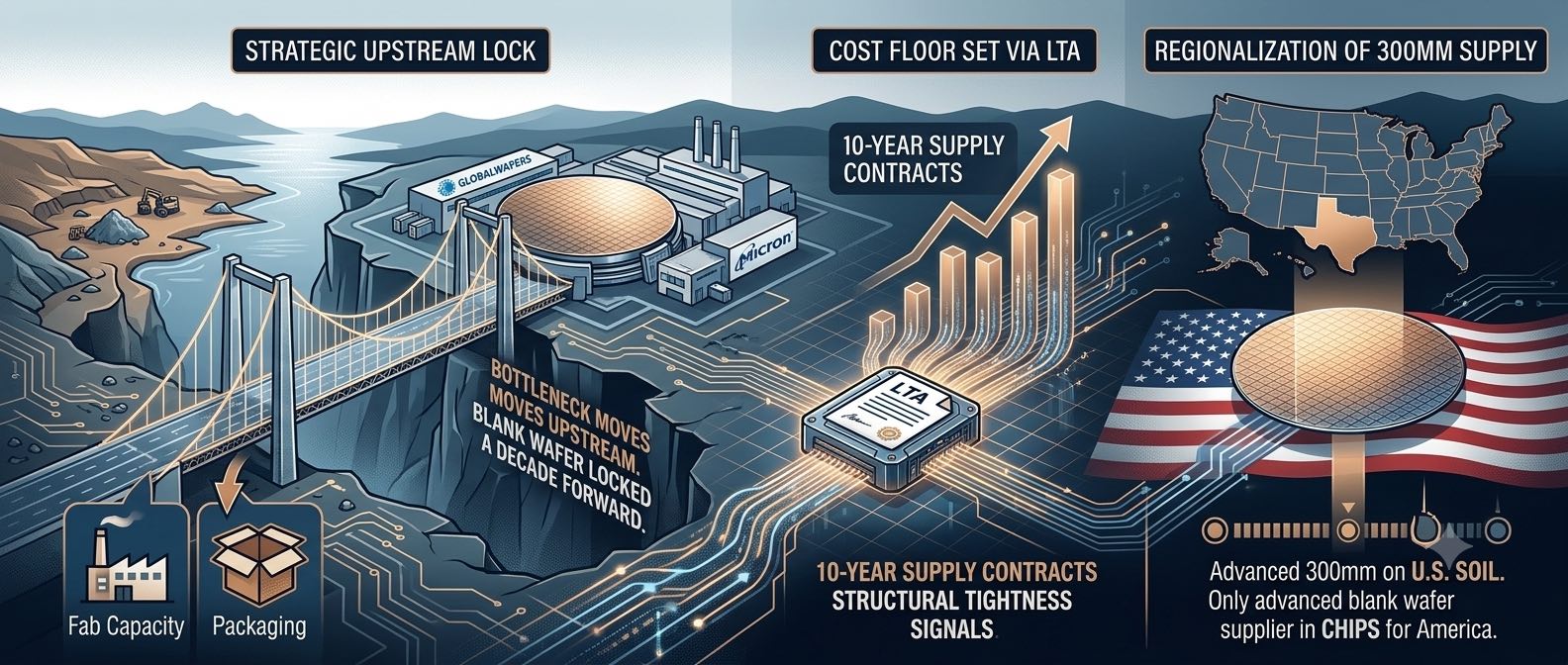
On July 9, Micron announced up to $3 billion to strengthen the U.S. semiconductor supply-chain ecosystem. The sharp edge of it: $500 million in strategic financing into GlobalWafers America's 300mm raw silicon wafer plant in Sherman, Texas, plus a ten-year supply agreement that locks a large slice of raw wafer capacity into Micron's long-term manufacturing plan.
Set the part basics straight first. A raw silicon wafer is the blank at the very top of the chain — no lithography, no circuits yet. No matter how strong a memory maker is, without that blank it can't run a line. Micron committing to a ten-year contract on that blank tells you what it's actually worried about: not fab capacity, but upstream substrate supply.
A few ways to read it on the desk:
- The floor goes up, not down. When a maker locks upstream supply for ten years, it's telling the market the tightness is structural, not a one-quarter blip. Stop pricing in a "next-quarter easing." The DRAM/NAND cost floor is only getting harder.
- Makers feed themselves first. Pulling a decade of substrate off the board means Micron is prioritizing its own long-term shipments. The flexibility left for the spot and secondary channel only shrinks. If you're holding matching parts, don't open your quote window too wide — keep a position.
- Localization = a partitioned supply chain. GlobalWafers is the only raw silicon wafer supplier in CHIPS for America capable of making advanced 300mm wafers on U.S. soil. Betting on it is betting on the "made-in-US, used-in-US" partition. If your BOM mixes U.S. memory with China/Asia delivery, start thinking dual-source now.
- Don't watch only Micron. GlobalFoundries rose on the same news. When substrate tightens, it's not just memory pulling 300mm — logic, power, and analog fight over the same pot. Power and auto-grade lead times are already long; with substrate locked up, don't expect near-term relief there either.
- Put 300mm wafer lead times on your watchlist. Buyers used to track fab utilization and back-end lead times. Now add one layer up — raw silicon wafer lead times and long-term-agreement coverage. Once the upstream is eaten by LTAs, the leftover spot flexibility becomes your cost-volatility source.
Deeper down: the real meaning of this money is that a maker just pushed the capacity fight up from the fab to the substrate. For two years the argument was about advanced-node availability and back-end congestion. Now Micron is telling you with hard cash that even the blank wafer at the very top is worth locking a decade in advance. When the leader starts hoarding raw material, every buyer down the chain has to reset cost expectations upward.
For anyone working spot and dead stock, that's not bad news. The tighter the raw material and the more makers lock, the more your matching inventory is worth. The move is to treat inventory like a position — lock what you should, hold what you should, and don't be the one taking the last handoff in a shortage cycle only to sell in a hurry.