Published on: June 19, 2026
Why Micron's June 24 Earnings Is the Real Test of the AI Memory Supercycle — Three Numbers Spot Buyers Should Watch
Micron reports FQ3 after the close on June 24, and Wall Street's revenue estimates span $33.7B to $40.9B. For anyone sourcing mainstream DDR5, DDR4, LPDDR, or enterprise SSD, this print signals whether makers keep diverting capacity into HBM or start loosening. Here are the three numbers that matter and what to do now.
June 24, after the close: Micron reports FQ3.
Stock traders watch the revenue headline. If you source parts, you don't. For you, this print answers a more practical question — do makers keep diverting fab capacity into HBM, or do they start loosening it back toward mainstream DRAM.
Start with the disagreement. Wall Street's revenue estimates for this single quarter run from $33.7B to $40.9B — more than $7B apart, roughly a fifth of the midpoint. When professional analysts can't agree within a fifth on one company in one quarter, it tells you nobody really knows how fast AI memory demand is ramping.
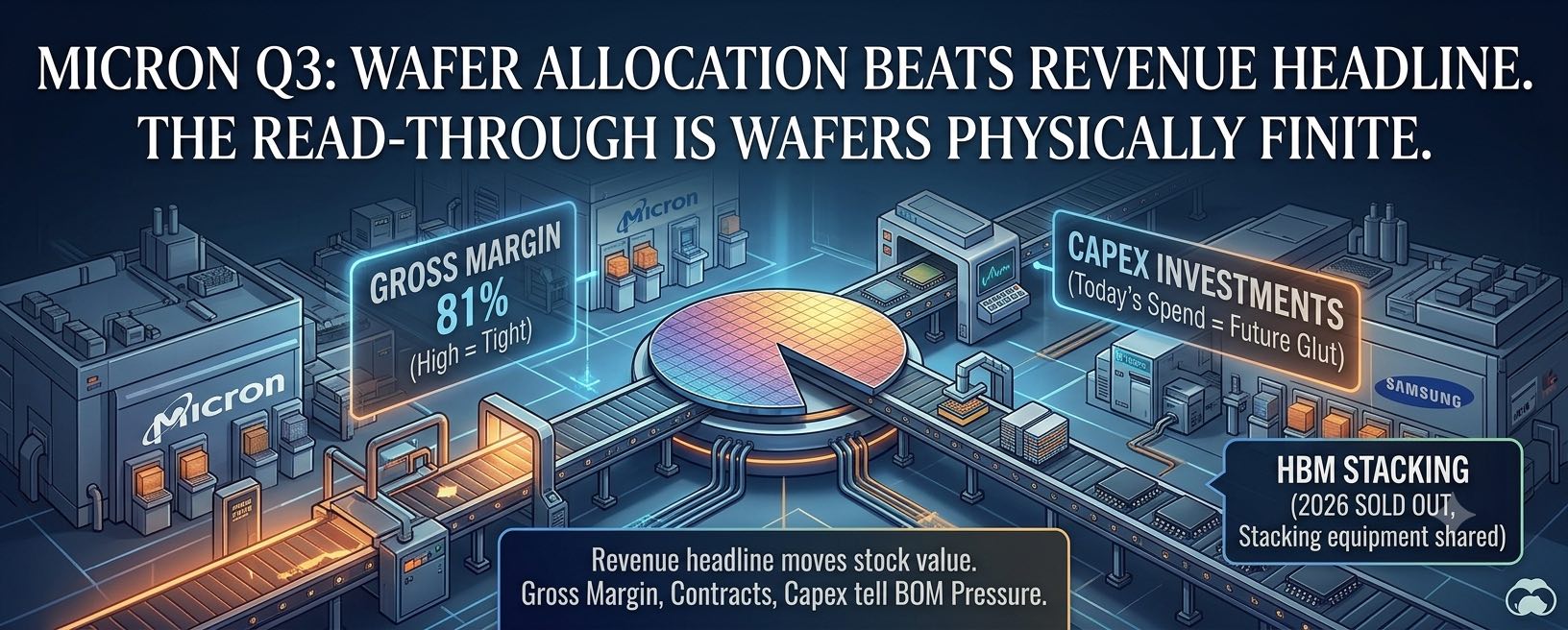
Micron's own guidance sits near the bottom of that band: about $33.5B revenue (±$750M), non-GAAP EPS near $19.15, gross margin around 81%. A year ago the same quarter earned $1.73 a share. A commodity supplier only jumps to nearly $19 when it briefly holds genuine pricing power.
What this print means if you buy parts
HBM capacity doesn't appear from nowhere. It comes off the same lines that make conventional DRAM. Only three companies make HBM at all — Micron, SK Hynix, Samsung. Micron has already said its entire 2026 HBM output is sold out under multi-year (three-to-five-year) contracts, with HBM4 12H 36GB shipping in volume since CQ1 for NVIDIA's Vera Rubin and a 48GB 16-high HBM4 already sampled.
Capacity locked into HBM means the shortfall in mainstream DDR5, DDR4, LPDDR, and enterprise SSD doesn't get backfilled. That's the mechanism behind TrendForce's Q2 numbers — conventional DRAM contract prices up 58–63% QoQ, NAND up 70–75% (background, not a new signal this week).
The three numbers to watch
First, gross margin. The 81% guide is far above Micron's historical norm and the cleanest gauge of HBM pricing power. When supply loosens, margin compresses before revenue does. Margin holding or expanding means parts stay tight; margin slipping means pricing may be peaking.
Second, 2027 contracts. Micron says 2026 is sold out and customers are signing three-to-five-year deals. If the call extends that visibility credibly into 2027 and 2028, this is structural, not just another cycle.
Third, capex. Every memory upcycle has historically ended when its own capacity expansion tipped supply into surplus. Today's spend is tomorrow's glut. The more aggressive the capex, the more you watch for a turn a year or two out.
What spot buyers can do now
Don't read a falling stock as loosening supply. How the shares move on the print has nothing to do with whether your DDR5 spot lot is tight. Even if Micron pulls back, the near-term shortfall in mainstream memory is still there.
Pre-position mainstream parts on your own clock, not the earnings calendar. HBM cannibalizing capacity is structural; June 24 just puts a public number on it — it isn't a turning point.
Run the math on NCNR. In this market, OEM and big-distributor quote windows are short and no-return terms are common. Align price and payment timing before you take a spot lot; don't sit on inventory at the top.
Watch the three: whether margin holds 81%, whether 2027 contracts get spelled out, how hard capex runs. The revenue headline moves the stock in the first minute; these three decide how long parts stay tight.