Published on: August 10, 2026
MLCC Repricing Wave Hardens: Samsung Electro-Mechanics +30% Lands, Taiyo Yuden Follows Sept 1 — Passives Become the Second Front Behind AI Servers
Memory headlines are so loud they buried the other line that is hardening fast: MLCCs. Samsung Electro-Mechanics' portfolio-wide +30% took effect August 1, Taiyo Yuden raises from September 1, and high-cap small-case lead times have stretched to 26-40 weeks. One GB200 board eats ~6,500 MLCCs. Here is how spot buyers and BOM owners should read it.
Memory is loud right now. Every channel, every chat — DRAM, NAND, HBM, allocation, post-settlement pricing.
Loud enough that the other line hardening underneath got buried: MLCCs.
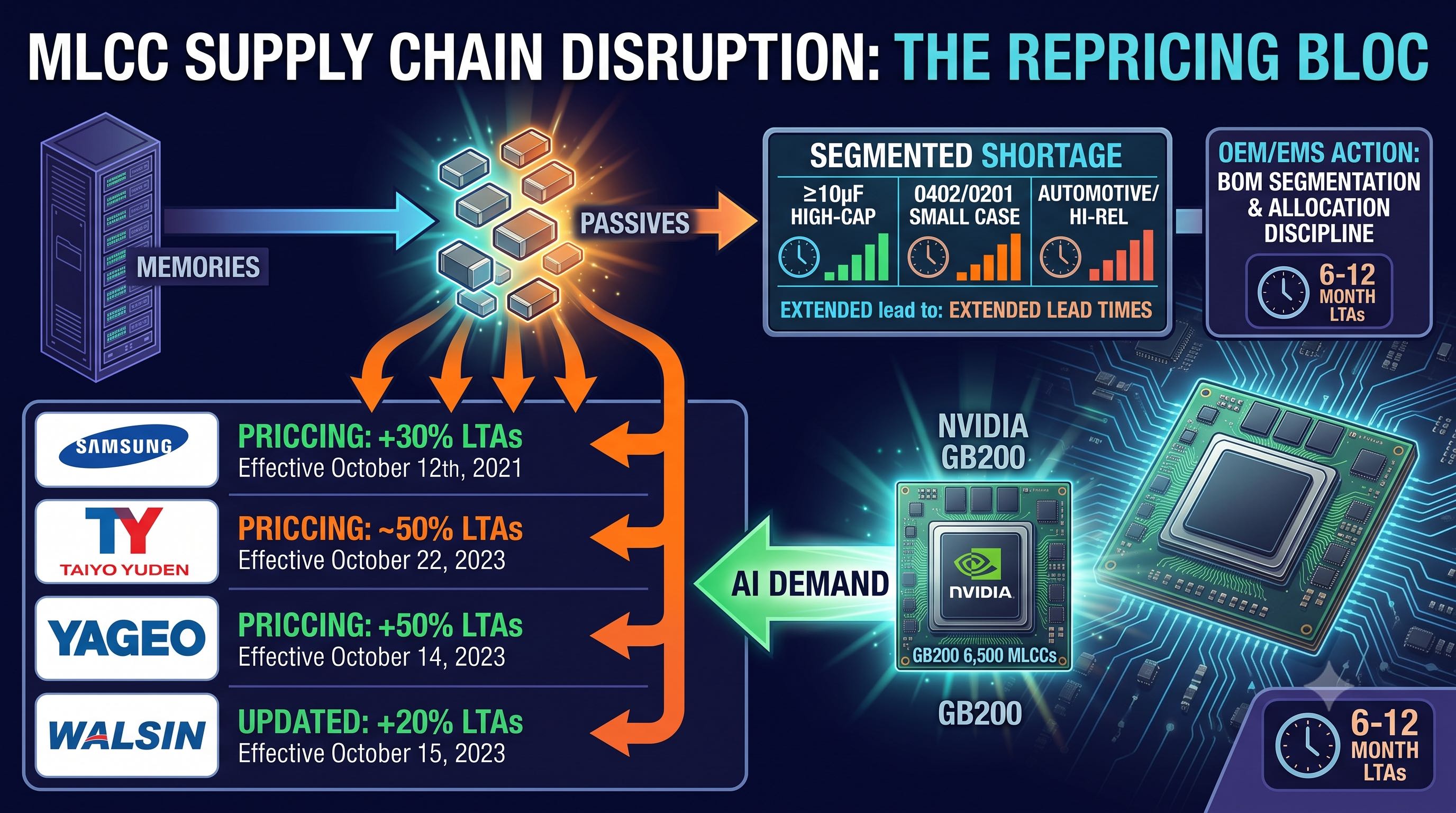
Here is the repricing calendar. All dated events, not survey pages:
- Samsung Electro-Mechanics (SEMCO): portfolio-wide +30%, effective August 1. Not one series — the whole book.
- Taiyo Yuden: raising from September 1, customer letter went out July 23. No uniform percentage; the driver is barium titanate, nickel powder, and rare-earth additive cost inflation.
- Yageo: ~+50%, July 1.
- Walsin: 5-15% on consumer grades.
Four makers, all moving inside one quarter. That is not a point event. That is a line turning together.
Why now?
Short version: AI servers ate through the passives.
One NVIDIA GB200 board carries roughly 6,500 MLCCs. Layer automotive on top — the high-reliability, high-cap tier — and demand goes vertical. June monthly shipments from the Japan/Korea top three (Murata, SEMCO, Taiyo) hit a five-year high.
The order book says it plainer. Book-to-bill ratios in June: Murata 1.30, SEMCO 1.31, Taiyo 1.25 — five-year highs. A BB ratio above 1 means orders are outrunning shipments and backlog is stacking. Murata's number has crossed the peak that preceded the 2018 capacitor crunch. Anyone who was buying then remembers what that looked like.
Which parts tighten first?
Not all MLCCs are equal. The real squeeze is here:
- ≥10µF high-cap
- 0402 / 0201 small case
- automotive / high-reliability series
These run 26-40 weeks, some 26-52+. Channel inventory is already below the 30-day warning line. Meanwhile, plenty of standard low-cap commodity parts are still available — don't blanket-treat everything as constrained.
How spot and BOM should read it
- Pull the BOM first. Extract every MLCC line, sort by capacitance + case + grade. Flag ≥10µF high-cap, 0402/0201, and auto-grade in red.
- Stop spot-quoting high-cap. That tier is allocation now, not spot. Buy it on a spot cadence and a lead-time reset will strand you.
- Lock Taiyo Yuden inventory before 9/1. September 1 is a hard window. If Taiyo passives sit on your BOM, verify exposure and place orders now.
- Put LTAs on the tight parts. 6-12 months, volume committed. JIT is suicide at a 1.3 book-to-bill.
- Don't run a memory-only calendar. Microchip repricing 8/14, Vishay SQ4532 last-buy 8/23, Taiyo Yuden 9/1 — three deadlines in a little over two weeks, and the passives one is the easiest to miss.
One line to close
You've watched memory for the better part of a year. Passives are only now repricing as a group. The real risk isn't the 30% number — it's the unglamorous 10µF 0402 on your BOM that quietly went to a 30-week lead time while you were looking at DRAM. Tightness usually shows up first where nobody's watching.