Published on: May 28, 2026
MLCC Lead Times Stretch to 40 Weeks as AI Server Boards Drain High-Capacitance Stock — The Next Front for Spot Buyers
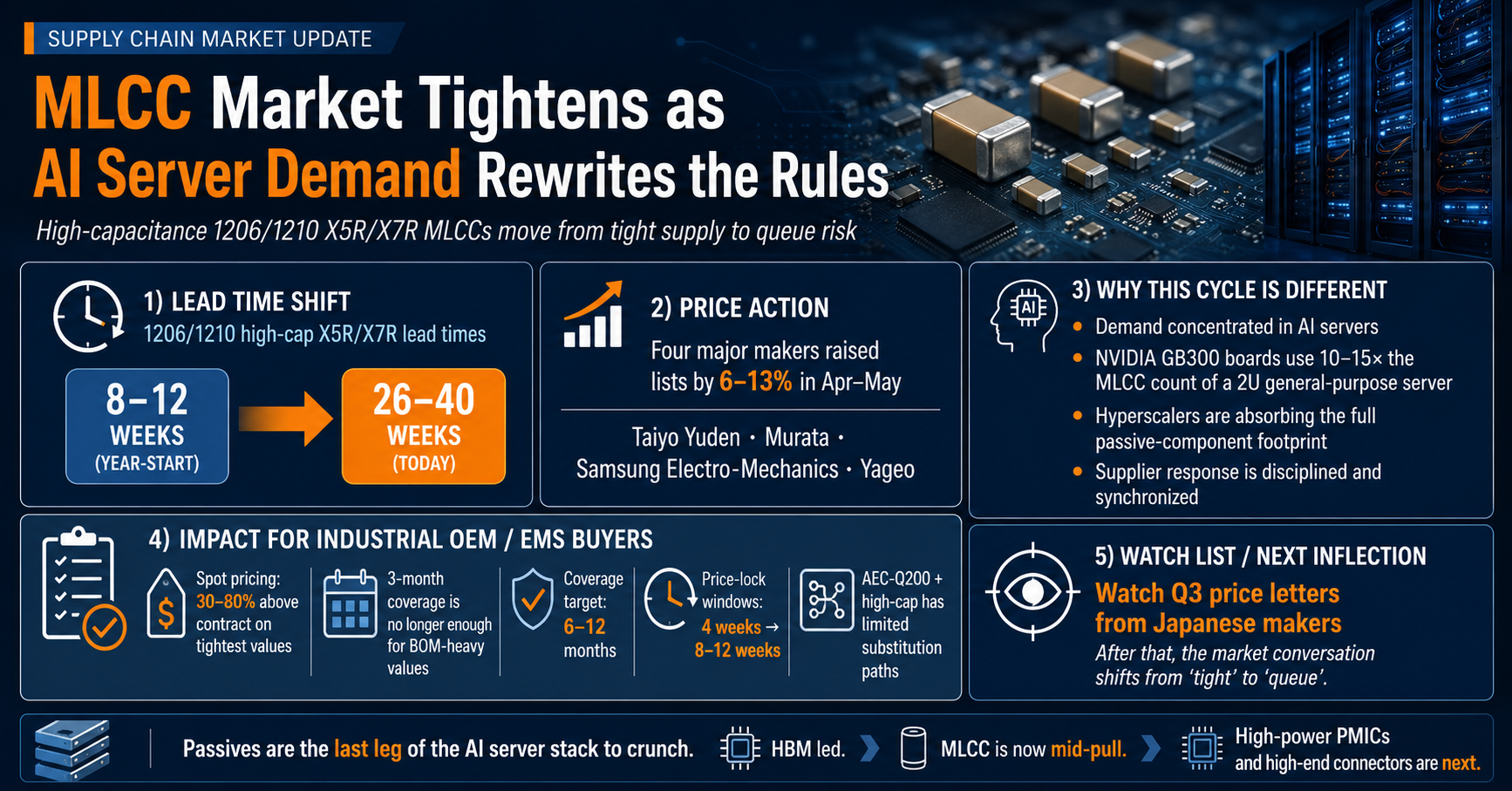
Taiyo Yuden, Murata, Samsung Electro-Mechanics, and Yageo all rolled 6-13% price hikes between April and May. 1206/1210 X5R/X7R high-capacitance lead times jumped from 8-12 weeks at year-start to 26-40 weeks. AI server boards burn 10-15x the MLCC count of general-purpose servers. Here's what spot, EMS, and industrial buyers need to do this quarter.
The memory shortage hasn't even cooled, and passive components are already heating up.
In April, Taiyo Yuden moved first with a 6-13% list increase on consumer and automotive low-cap MLCCs. Murata, Samsung Electro-Mechanics, and Yageo followed in May with the same range. The class everyone actually cares about — 1206/1210 22-100 µF X5R/X7R, the parts that sit on every AI server board — moved from 8-12 week lead times at the start of the year to 26-40 weeks today.
This isn't one part number running short. It's the entire passive component industry switching tracks.
Why this cycle differs from 2017-2018
The last MLCC crunch was driven by automotive electrification stacking on top of consumer and industrial demand at the high-cap end. This one is driven almost entirely by AI servers. A single NVIDIA GB300 board consumes roughly 10-15x the MLCC count of a 2U general-purpose server. Hyperscalers aren't just buying GPUs — they're absorbing entire high-power baseboards, where power regulation, filtering, and decoupling MLCC counts dominate the BOM in a way they didn't before.
Japanese, Korean, and Taiwanese makers have responded predictably: route premium capacity to AI, automotive, and medical; let consumer pricing rise to throttle demand. Samsung Electro-Mechanics has publicly framed this as "capacity flex repositioning for AI."
What it means for spot / EMS / industrial buyers
- 1206/1210 22 µF / 47 µF / 100 µF X5R/X7R is the tightest band of the cycle. Almost every AI server BOM, BMS for energy storage, and industrial power supply lands on these values. Murata GRM series, Taiyo Yuden EMK series, and TDK C series are tight in parallel.
- Spot pricing is already running 30-80% above contract price. EMS shops were pricing into the secondary market by late April; industrial OEMs reacted in May, a beat slower.
- The 26-40 week posture from the four big makers effectively ends the "standard schedule + rolling top-up" inventory model. Buyers need to rebuild from scratch: lift coverage on BOM-heavy capacitor values to six months plus, run dual-source plus secondary in parallel, and extend price-lock from 4 to 8-12 weeks.
How to play it
Tier 1: if you hold inventory, lock quotes today. Industry chatter points to a Murata second-wave hike in Q3 — current pricing is the floor. With AI server board makers and EMS accounts, the only path to preserving margin is to push and lock proactively.
Tier 2: for new RFQs with BOM flexibility, work the capacitance ladder across Yageo, Walsin, Samsung Electro-Mechanics, Vishay, and KEMET. Murata and Taiyo Yuden high-cap parts in particular are spot-priced into nosebleed territory; if a consumer or industrial program can substitute around them, do it. AEC-Q200 + high-cap is the hardest-hit band — no clean substitution path there.
Tier 3: reopen contract terms with long-term customers. This isn't a swap-the-OEM-and-escape situation; the whole industry moved in lockstep. Write BOM-risk language into supply contracts. Quarterly price reviews are the only structure that survives 2026 cleanly.
The next risk window
If Murata's Q3 second wave lands and AI server board volumes continue expanding, 1206/1210 high-cap walks from "tight" to "no spot available." At that point even secondary-market pricing requires a queue. Three things to watch: the July-August Q3 price letters from Japanese makers, Murata's order flow tied to NVIDIA Rubin baseboards, and the capacity rebalancing between Samsung Electro-Mechanics and LG Innotek.
Passives are the last leg of the AI server stack to crunch. HBM led, MLCC is now mid-pull, and the next wave will hit high-power PMICs and high-end connectors. Every quote a buyer locks today, every dual-source they validate, decides how much margin survives Q3 and Q4.