Published on: July 29, 2026
NXP Booked a Record Automotive Quarter and the Stock Still Fell 8% — The Spot-Buyer Read
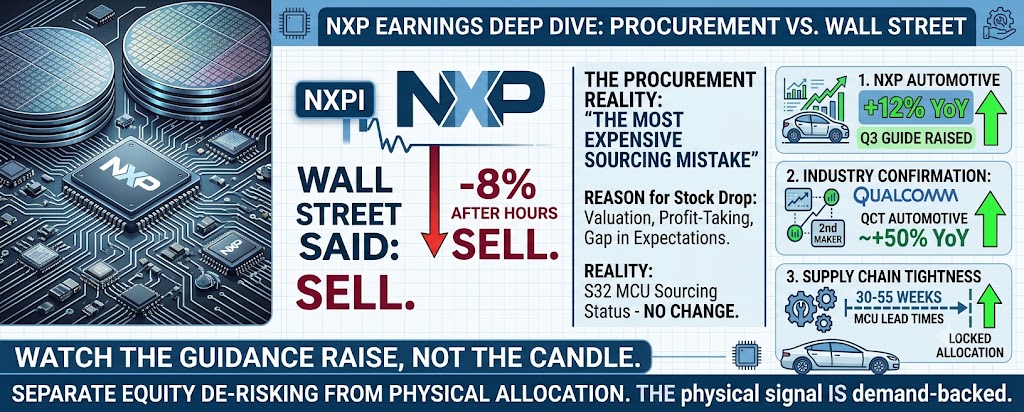
NXP beat on revenue and EPS in Q2 2026, grew automotive +12% YoY (+17% ex-MEMS), and raised Q3 guidance — and the stock still dropped ~7.7% after hours. The real signal isn't 'NXP fell.' It's that financial-market sentiment and physical allocation are running on two separate tracks. Here's how to quote and negotiate automotive parts around that.
Facts first.
NXP Q2 2026 (07-28, after US close): revenue $3.5B, adjusted EPS $3.61 — both above the $3.50 Street. Automotive revenue $1.94B, +12% YoY, or +17% if you strip out the MEMS-sensor business sold earlier this year. The three growth drivers — software-defined vehicle, electrification, connectivity — are ~47% of automotive revenue and growing low-20s%. Q3 guide raised: ~$3.75B revenue midpoint, ~$4.11 EPS midpoint.
Every number green. Then the stock fell ~7.7% after hours, $267.67 to $247.
A spot buyer's first reaction is easy: the maker dropped — is this softening?
Read it the other way.
The share price fell on valuation and an expectations gap, not on units. The market had already priced in the automotive recovery; NXP merely met it instead of blowing past it, so funds took profit. That has nothing to do with whether you can source one S32 vehicle-control MCU or how long the lead time runs.
The actual physical-supply signal is in these lines:
- Automotive +12% YoY (+17% ex-MEMS), Q3 guide raised again — auto silicon demand is not rolling over.
- Qualcomm's 07-29 print pre-signals QCT automotive ~+50% YoY — two makers, same message: auto is pulling, not receding.
- MCU lead times still sit at 30–55 weeks; automotive memory keeps going long-contract; passives stay on locked allocation.
Put those together and the conclusion is hard: the tightness in automotive parts is demand-backed, not sentiment-backed. That 8% has no bearing on your quote.
What that means at the desk:
One, don't take the 'even NXP dropped, so cut your price' line. Separate stock de-risking from spot allocation — the maker's quarterly shipments are up and its guide is up, so leading automotive parts stay tight. Ease first and you're just giving margin away.
Two, keep quoting automotive MCU / analog / auto-grade memory at tight allocation and long lead times. S32 family, radar front-ends, in-vehicle Ethernet PHYs, automotive PMICs — the gap Tier-1s can't fill on their own long-contracts still spills to the channel, so your spot inventory has pricing power. Keep validity at 24–48h.
Three, watch the guidance raise, not the share price. A maker willing to raise next-quarter revenue is confident in its backlog and utilization. That says more about the automotive cycle than any single after-hours move.
Four, treat the 'financial market vs physical allocation' divergence as a reusable read. It's not just NXP this week: SK Hynix also posted a record Q2 and its stock had sold off ahead of the print. Memory and automotive both confirm the same thing — makers are printing money, parts are tight, but capital-market mood keeps its own rhythm. If you trade parts, you watch inventory and allocation, not the candles.
One line for the trade: the most expensive mistake in this business is reading someone else's profit-taking as your cue to concede. NXP's 8% is the reminder — quarterly up, next quarter up, and no reason for your automotive parts to soften first.