Published on: August 3, 2026
Qualcomm's Sept 1 Across-the-Board Hike: Memory Inflation Just Landed on Your SoC Quote — How Spot Buyers Should Read It
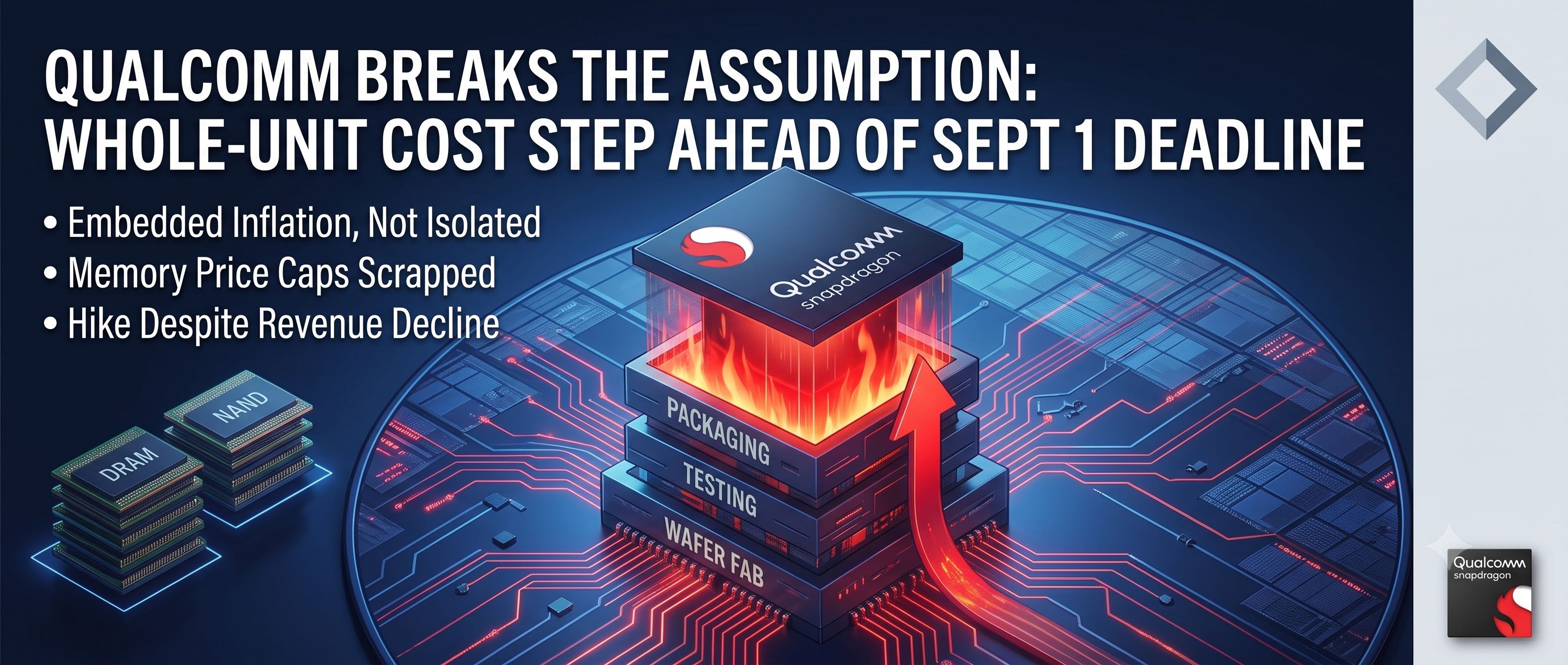
Qualcomm is raising Snapdragon prices across the board on Sept 1 and said the quiet part out loud: memory, test, and advanced-packaging input costs are all up. This is the first time memory inflation shows up not as "DRAM/NAND went up again" but as an SoC price sheet. For spot buyers, the quoting logic changes — non-memory BOM is now in the hike lane, and someone will follow.
The facts first.
On its FQ3 call, Qualcomm said Snapdragon prices go up across the board on September 1. No number given; the market reads it as double-digit percent. CEO Cristiano Amon's line was blunt: "Cost went up, prices are going to go up."
The move isn't the story. The attribution is.
Qualcomm spelled out the cause: wafer fabrication, assembly and test, advanced packaging, and memory — input costs across the board. This isn't Qualcomm reaching for margin. Its own inputs are up, it can't absorb them, and it's passing them down.
That's today's real signal — memory inflation, for the first time, isn't landing on your desk as "DRAM up again / NAND contract up again." It's landing as an SoC price sheet.
Why this matters to the spot desk
For most of the past year, buyers have handled memory inflation the same way: one line for DRAM, one for NAND — priced and watched separately — with the rest of the BOM left alone.
Qualcomm just broke that assumption. The chain, in plain terms:
- Memory up → module/SoC makers using that memory can't absorb it → SoC up → your whole-unit BOM up.
- Once one company walks that path openly (Qualcomm is the first big one), the next one has no psychological barrier to following.
What likely happens next
- MediaTek-class SoC houses following is a high-probability outcome. Same reason: their memory and packaging costs are up too. Qualcomm moving first de-risks the "raise prices" decision for everyone.
- On Snapdragon-based models and modules, pre-Sept-1 is the "old price," post-Sept-1 is the "new price," with no buffer between.
- Memory upstream hasn't eased either: SK hynix has removed price caps from its long-term agreements, Q3 conventional DRAM contracts are +13–18% and NAND +10–15% — narrowing but still one-directional. If the top of the stack doesn't cut, the cost pressure at the SoC layer doesn't drain.
Spot-buyer playbook
- The lock window closes at end of August. If you carry Snapdragon-platform demand, lock the pre-Sept-1 quote now. This is a hard date, not a "let's watch it."
- Don't quote just two lines. When a customer asks "how much did memory go up," the old answer was DRAM/NAND. Now flag it proactively: non-memory BOM is rising too, and SoC is the first one out in the open. Quote "memory up" and "SoC up too" as separate stories so the customer can't hold you to a stale assumption.
- Pre-warn on follow-the-leader. If your customer runs MediaTek or another SoC, don't wait for the formal notice. Qualcomm cracked the door; a follow is a matter of timing. Setting expectations early beats explaining after the fact.
- Keep quoting memory as a tight part on short-dated offers. Some customers will push back with "the increase is slowing, isn't it topping?" Narrowing isn't peaking — SK's cap removal and the shortage-through-2027 line are both on the record. Hold 24–48h validity; no long-dated commitments.
One-line read
The thing to watch about memory inflation isn't "how much more this quarter." It's that it's changing form — from the price of one line item into a price sheet for an entire category (SoC).
Qualcomm is the first big maker to put that in writing. It won't be the last. What buyers need to adjust isn't a quote on one part number — it's the now-obsolete mental model that memory inflation only touches memory parts.