Published on: July 1, 2026
A Single $294M MLCC Long-Term Deal Just Locked Away More AI-Server Capacitor Capacity — Which Parts and Windows Spot Buyers Should Watch
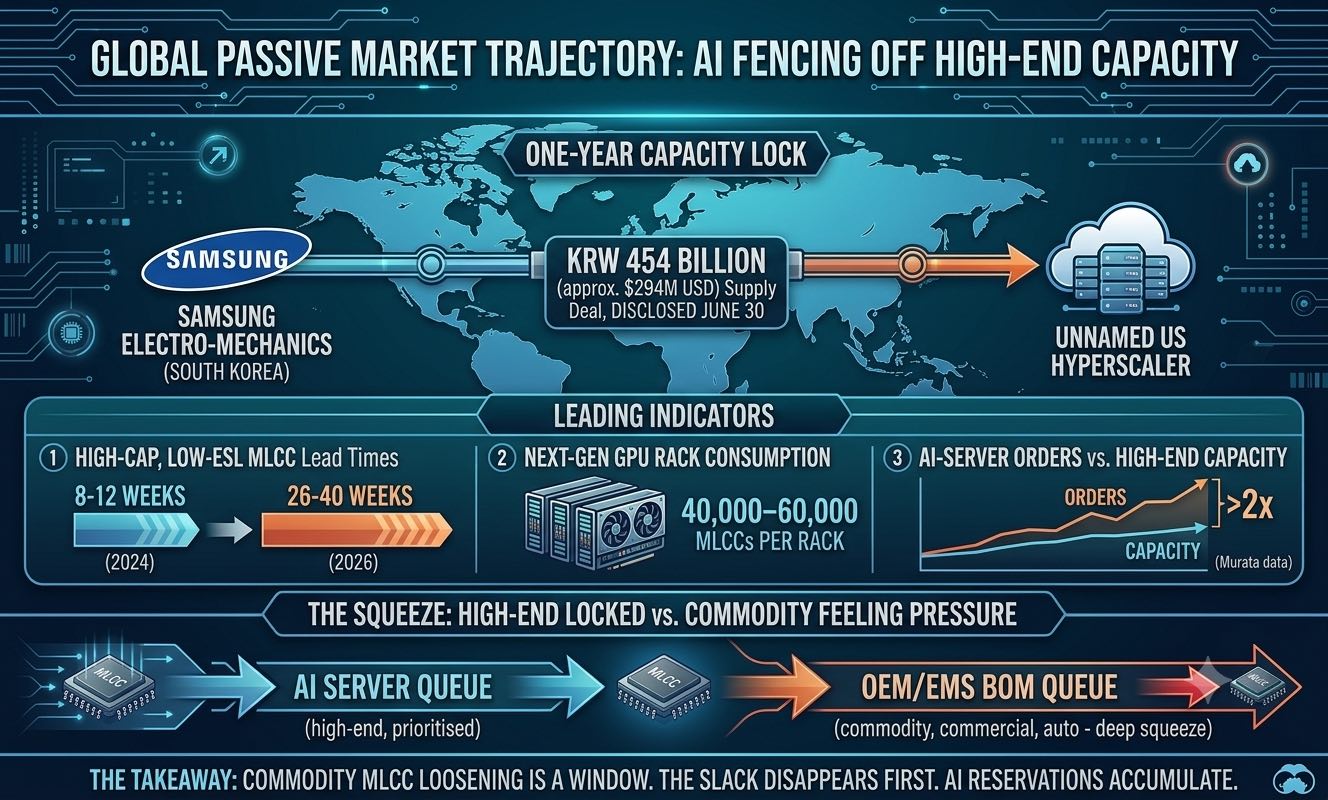
On June 30, Samsung Electro-Mechanics disclosed a one-year MLCC supply contract worth about $294M with an unnamed US cloud provider, shipping from January 2027. The dollar figure is small; the signal is not. This is capacity being locked by contract, not another price hike — and for spot and secondary-channel buyers, the parts to move on are the high-cap codes sitting in your own BOM.
The headline is not "another maker raised prices." It is "capacity got locked by a long-term contract." Different animal.
On June 30, Samsung Electro-Mechanics filed a regulatory disclosure for a one-year deal: KRW 454 billion, roughly $294M, supplying MLCCs for AI servers. The customer is unnamed. The market is pointing at a top-tier US hyperscaler — Google, AWS, Meta, that class. Shipments start January 1, 2027.
The dollar figure looks modest. For a maker doing billions a year, $294M is not the story. Reading the contract value is the amateur move. What matters is which slice of capacity this contract fences off.
Why this one is worth stopping for
- It is a publicly disclosed long-term contract, not a rumor. When a top-three MLCC maker files a regulatory notice to lock a year of output for one customer, high-end AI capacitors have moved from "fight for spot" to "lock the long deal."
- It fences off high-end capacity, not commodity parts. AI servers want the high-capacitance, low-ESL tier — the tier that was already tight.
- One-year term, shipping from January 2027 — meaning the maker has to reserve and pre-schedule that capacity now, squeezing the room left for everyone else's orders this half and next.
Why high-end getting locked means spot buyers should watch commodity parts
Fab capacity is finite. When a high-margin AI order arrives and gets signed as a long-term deal, the maker tilts its line loading toward it. What gets pushed out is general-purpose commercial-grade and some automotive-grade MLCC — exactly the parts EMS and spot buyers carry in volume and short most often.
Look at current lead times: high-cap, low-ESL MLCC ran 8–12 weeks in late 2024 and now sits at 26–40 weeks in 2026; high-cap 1206 / 1210 case sizes are broadly past 20 weeks, with some codes flat out of stock. A single next-gen GPU server rack eats 40,000–60,000 MLCCs just for filtering, decoupling and signal integrity. Even doubling high-end capacity does not feed that (Murata has said AI-server MLCC orders exceed twice its high-end capacity).
What spot buyers should actually do now
- Pull your BOM and flag the high-cap codes first — high-cap 1206 / 1210, and high-cap 0402 / 0201. Those are the case sizes AI demand strips directly.
- Do not wait on commodity commercial and automotive MLCC. As lines tilt to high-end, commodity lead times loosen first, then tighten. If you can source from stock or match through channel, stage inventory while the secondary and spot channel still has parts.
- NCNR and allocation terms are coming back. As makers lock long deals, distributors tighten credit and inventory terms. Spot parts without NCNR strings right now are the window.
- Do not watch only Samsung EM. Murata, Taiyo Yuden and Yageo move in step — one signs a long deal, the others' high-end capacity tightens too, and commodity gets dragged along.
One line for the arbitrage desk: this contract does not move spot prices by itself, but it is a direction signal — high-end capacity is being sliced away by long deals, and the commodity MLCC spot and secondary channel becomes the release valve. Whoever staged the right high-cap commodity codes first has the leverage to match orders in the second half.
(Background, not this week's new signal: Murata already raised AI-server / auto / RF MLCC 15–35% on April 1; Samsung EM 15–20% in May; Taiyo Yuden ~6–25% in Q2; Yageo via Kemet 10–15%. Continuation background, not a fresh signal.)