Published on: May 19, 2026
Semiconductor Signals This Week: Samsung, CXMT, Nvidia H200 and India's First Fab
Four developments from the past three days — Samsung's strike risk, CXMT's revenue jump, Nvidia's H200 China uncertainty, and the Tata-ASML India fab — all point in the same direction: AI demand is reshaping memory, supply risk and global semiconductor capacity. What it means for OEM, EMS and industrial buyers.
The semiconductor industry is heading into another volatile stretch. Several developments over the past three days look unrelated on the surface but point in the same direction — AI demand is still reshaping memory, sourcing risk and global semiconductor capacity. Taken together, they describe how supply chain risk for buyers is changing shape.
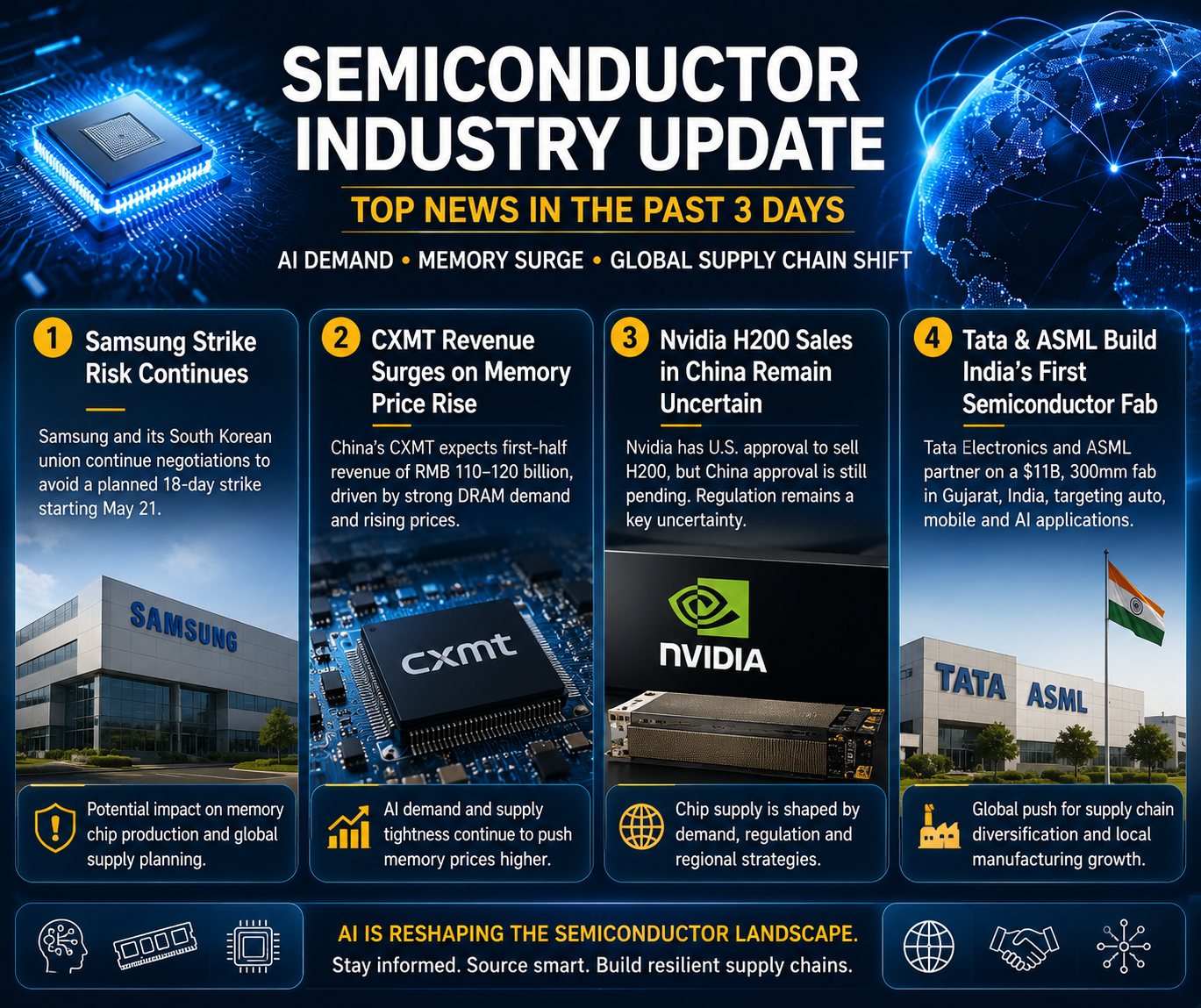
Samsung Electronics and its South Korean labor union are still in talks to head off a planned 18-day strike starting on May 21. Any disruption at the world's largest memory chipmaker would flow quickly into DRAM, NAND and AI-related component supply — even before any production line actually pauses, customer confidence and supply planning typically start adjusting in advance.
China's CXMT expects first-half revenue of RMB 110 to 120 billion, a sharp jump driven by rising DRAM prices and strong memory demand from AI computing. The reading is consistent across the market: memory has moved beyond a cyclical commodity and is becoming a strategic layer of AI infrastructure, with pricing power following that shift.
Nvidia's H200 sales into China remain uncertain. Even with U.S. export licenses in hand, China-side approval is still pending. Chip supply is increasingly shaped by regulation and regional industrial policy as much as by raw demand — a dimension procurement teams now need to factor in alongside price and lead time.
Tata Electronics and ASML are moving forward with India's first front-end semiconductor fab — an USD 11 billion, 300mm project in Gujarat targeting automotive, mobile and AI applications. It's another concrete sign that countries and companies are accelerating supply chain diversification away from single-region concentration.
For OEMs, EMS manufacturers and industrial customers, the practical lesson is that supply risk is no longer just about whether parts are in stock. It now includes labor disputes, export rules, qualification limits, regional capacity shifts and how "usable" the inventory you can find actually is for your specific project.
At CHIPPONG we continue to track memory, storage and broader semiconductor supply trends — the goal is to help customers identify reliable sourcing options before urgent demand turns into a supply problem. The work is less about finding the lowest price and more about judging which parts to secure earlier, which models have realistic alternatives, and which inventories actually carry market value once brand, package, date code, traceability and qualification are accounted for. With AI demand, regional capacity shifts and tightening regulatory layers all moving at once, the market is unlikely to settle down soon — the companies handling it best are the ones whose procurement and inventory strategies look forward rather than react to last quarter.
CHIPPONG provides practical sourcing support for OEMs, EMS providers and electronics manufacturers navigating the global semiconductor market.