Published on: July 6, 2026
SK hynix Lists on Nasdaq July 10: How the HBM Leader's Capital-Market Move Reshapes the Allocation Signal for Spot Buyers
SK hynix lists ADRs on Nasdaq on July 10, with Samsung's Q2 preliminary print landing July 7. Together they tie the memory leader's capacity pricing to the capital markets. For spot buyers and industrial OEMs this is not a finance headline — it is a 2026-2027 allocation weathervane. Here is how to read it across parts, timing and channel.
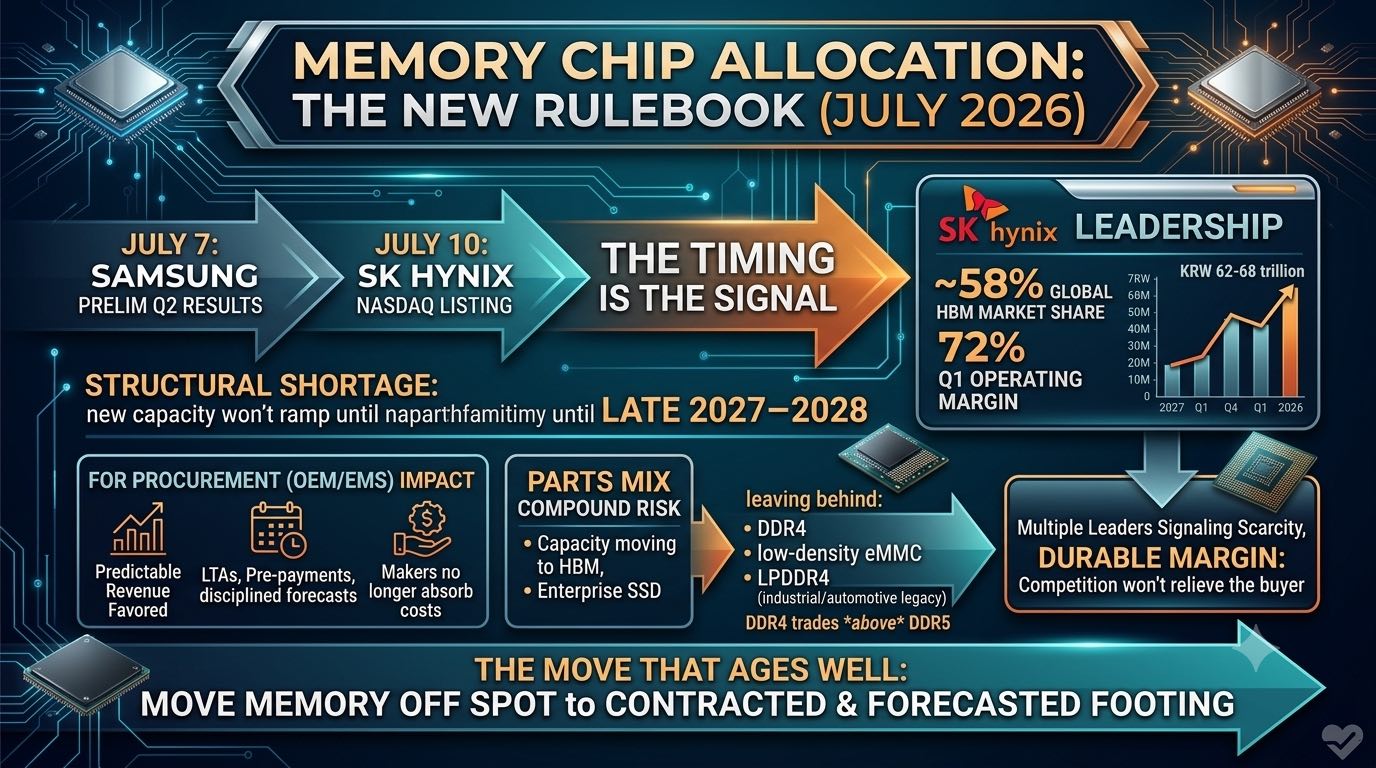
On July 10, SK hynix lists ADRs on Nasdaq. Samsung posts its Q2 preliminary results three days earlier, on July 7. The timing is not accidental.
Start with the numbers. SK hynix holds roughly 58% of the global HBM market, ran a 72% operating margin in Q1, and carries a Q2 operating-profit consensus in the KRW 62-68 trillion range. A vendor that cannot make AI memory fast enough is choosing this exact moment to list in the US.
For anyone sourcing parts, there are three layers to read.
Layer one: parts. The leader's money is in HBM and enterprise SSD, so that is where capacity flows. What gets squeezed out is DDR4, low-density eMMC and LPDDR4/LPDDR4X. If the fab will not schedule your legacy build, the secondary channel is where you end up — and the price inversion, where DDR4 trades above DDR5, is already here and not reversing near-term.
Layer two: timing. A listing capitalizes several years of forward capacity expectation. Translated into procurement: the leader prioritizes allocation for customers who sign long-term agreements, pre-pay, and hand over a full-year forecast. Spot demand sits at the back of that queue by design. So do not wait for spot to loosen — push Q3-Q4 volume into LTAs now, or pre-buy against a basis above today's price.
Layer three: channel. With supply locked into LTAs and CSPs taking the bulk, the residual for general consumer and industrial parts gets pushed onto the spot and secondary channel. For traders that cuts both ways: parts are harder to find, but the spread opens up precisely in conditions like this. Whoever holds real DDR4 or eMMC stock with a verifiable date code holds the leverage.
On the July 7 Samsung print, do not fixate on the revenue line. Watch the HBM3E/HBM4E supply guidance. How the leader schedules H2 capacity — and whether it adds any — is the allocation weathervane for the back half. When the print lands, isolate three keywords: HBM supply, DDR5 contracts, enterprise NAND. Those set the basis for your Q4 quotes.
Actions you can take now:
- Pull DDR4, eMMC and LPDDR4 legacy parts out of your BOM and lock the last-time-buy window before the official EOL.
- For Q3-Q4 memory, sign LTAs where you can; where you cannot, pre-buy against a basis above spot.
- On the spot side, whoever can quote an accurate DC/lot wins first — keep your inventory organized by part, quantity, package and date code so you can respond instantly.
- After July 7 and July 10, re-read the HBM supply guidance before you fix your Q4 quoting basis.
The leader's listing is not a nudge to buy its stock. It is a message to the whole chain: memory pricing power is being held tighter for the next several years. What a spot buyer can do is get three things straight inside that tighter structure — parts, timing, channel.