Published on: August 17, 2026
SK Hynix Just Opened a Labor Front at the World's #1 HBM Maker — What Spot Buyers Should Actually Track
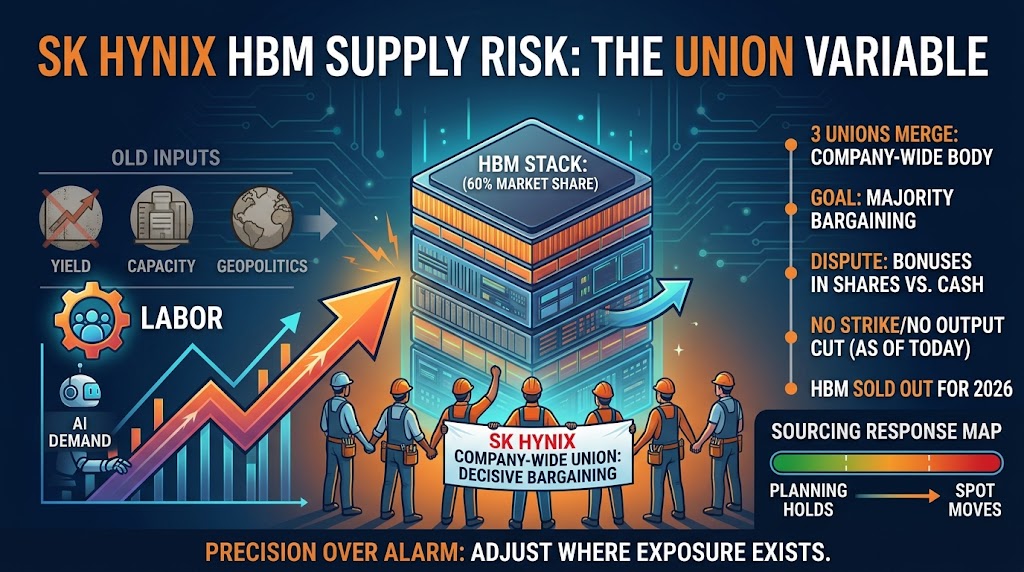
On August 13, SK Hynix's Korean workers merged three fragmented unions into a single company-wide body, with wage talks stuck on one thing: management wants to pay bonuses in shares instead of cash. No strike yet — but it's the first time the world's largest HBM maker has opened a labor front at the tightest point of the allocation cycle. This isn't equity noise; it's a real supply-side tail variable. Here's how spot buyers should read it, what to watch, and when to move.
Let's get the facts straight first.
On August 13, SK Hynix's Korean employees merged what used to be three unions — split by job function and by site — into one company-wide union. Around 2,500 joined in the first wave, out of roughly 35,000 Korean staff. The stated goal is blunt: sign up a majority, take a majority of the seats, and put real weight behind the bargaining position.
The fight is about bonuses. Last year, labor and management struck a 10-year deal to pay bonuses in cash from 10% of annual operating profit. This year management wants to pay most of it in shares instead. For context, Samsung's comparable arrangement pays a special bonus in stock from 10.5% of semiconductor operating profit. So the anger isn't out of nowhere: in the most profitable year the memory business has ever seen, the company wants to swap cash-in-hand for paper that locks up.
As of today: no strike, no output cut. Say that plainly — don't spook yourself.
So why should a spot buyer stop and look? Because the company in question is SK Hynix — the world's #1 HBM supplier, roughly 60% share. Its output cadence sets the tightness of the entire AI-server chain. And this labor variable happens to land right in the tightest allocation window.
How to read it
One: this is a tail risk, not a shortage today.
The unified union just formed. It doesn't have a majority yet, and talks are still at the table. Right now the physical impact on spot and lead times is zero. Anyone using this headline to tell you "HBM is about to run dry, chase it now" is trading the news at your expense. Pass.
Two: there are exactly two triggers worth watching.
- Whether the union actually reaches a majority — past 50%, the leverage changes in kind.
- Whether talks escalate from "deadlocked" to partial stoppage or output action — only once it touches the line does it become a physical event.
Until those two nodes hit, schedule as usual. When they hit, secondary-market spot will move ahead of contract prices — that's your signal to act.
Three: don't blend this with the equity tape or Samsung's HBM4 yield.
Two other items ran the same week as backdrop: Samsung's HBM4 yield reportedly hit ~80% (catching up), and NVIDIA anchored a ~$500B AI financing consortium. Those are demand-side and competitive-landscape stories; SK Hynix's labor dispute is a supply-side one. They're different animals. Demand not cooling + a new supply variable at the #1 maker = the risk vector only tilts tighter, not looser. Don't let "Samsung caught up, maybe it eases" pull you off course.
What a spot buyer should do
Sort your parts into three buckets.
HBM / server DDR5 / enterprise SSD — directly exposed to SK Hynix output. Don't schedule H2 as "smooth" supply. Keep locking 2027 allocation where you should; scheduling to tight supply beats betting on a pullback.
Consumer DRAM / LPDDR / eMMC — indirectly exposed. Already squeezed as capacity tilts to AI servers; a labor variable only makes allocation less elastic. Price allocation risk into quotes; don't commit to customers on spot terms.
Parts unrelated to SK Hynix — business as usual. Don't blanket-hike every memory line on the back of one Korean union story; that just burns your credibility.
Three near-term nodes, in passing
The week's price/EOL calendar hit a few marks too — clear them alongside the labor story:
- Microchip's 8/14 adjustment is now fully at new levels; re-cost affected part numbers into BOMs.
- Vishay SQ4532AEY-T1_GE3 last-buy is 8/23 — ~6 days left; place LTBs now on any BOM carrying it.
- Taiyo Yuden MLCC follows on 9/1; lock pre-9/1 stock on passives-heavy BOMs.
One line to close
At its core, this adds a human variable the AI-memory supercycle didn't have before — to a machine that's been running single-direction up. The machine hasn't stopped, but the human variable means HBM/DDR5 supply now carries one more line to watch alongside yield, capacity and geopolitics: labor. It doesn't bite today. But it's already on the table. This business runs on information edge and timing — and a variable that "hasn't fired but already exists" is exactly where you get to be half a step ahead.