Published on: August 24, 2026
STMicroelectronics' Third 2026 Price Increase Took Effect August 23 as Power Device Lead Times Reach 52 Weeks
STMicroelectronics' third price increase of 2026 took effect on August 23, covering power ICs, general-purpose MCUs, NFC RF chips and power semiconductors, with automotive MCUs up a cumulative 15–20%. Power device lead times generally exceed 30 weeks and reach 52 weeks on some parts. Placed alongside TI's five adjustments in twelve months, NXP's 5–15% effective August 1 and Infineon's 10–20% in July, analog and power repricing has moved from individual supplier action to a category-wide pattern. This piece breaks down the cadence of the three rounds, the mutual reinforcement between lead times and pricing, and what remains verifiable on the secondary channel side.
1. What has already happened
STMicroelectronics' third price increase of 2026 took effect on August 23.
Coverage: power ICs, general-purpose MCUs, NFC RF chips, power semiconductors. The percentage for this round is undisclosed.
One cumulative figure is public: automotive MCU prices are up 15–20% against prior levels.
Stated drivers are strong demand across multiple sectors together with rising transportation, energy, raw material and manufacturing-services costs.
For the secondary channel, the tense matters most. The effective date has passed. ST orders not price-locked before August 23 transact at the new level.
2. The cadence of the three rounds
The rhythm of the three 2026 rounds is measurable:
- Round one: announced March 24, effective April 26. Thirty-three days from announcement to effect.
- Round two: announced May 28, effective June 28. Thirty-one days.
- Round three: reported August 21, effective August 23.
The gaps between effective dates are 63 and 56 days respectively, or roughly one round every two months.
The direction of coverage expansion is equally clear. It started with automotive power parts, widened to general-purpose MCUs and power ICs in round two, and added NFC RF in round three. Each round is not a repeat of the previous one; it folds in categories the previous round left out.
Extrapolating that cadence places a fourth round somewhere around October. That extrapolation is a rhythm read, not a supplier announcement, and it belongs in long-term agreement terms as grounds for an adjustment mechanism rather than in a quotation.
3. Lead times are the underlying condition
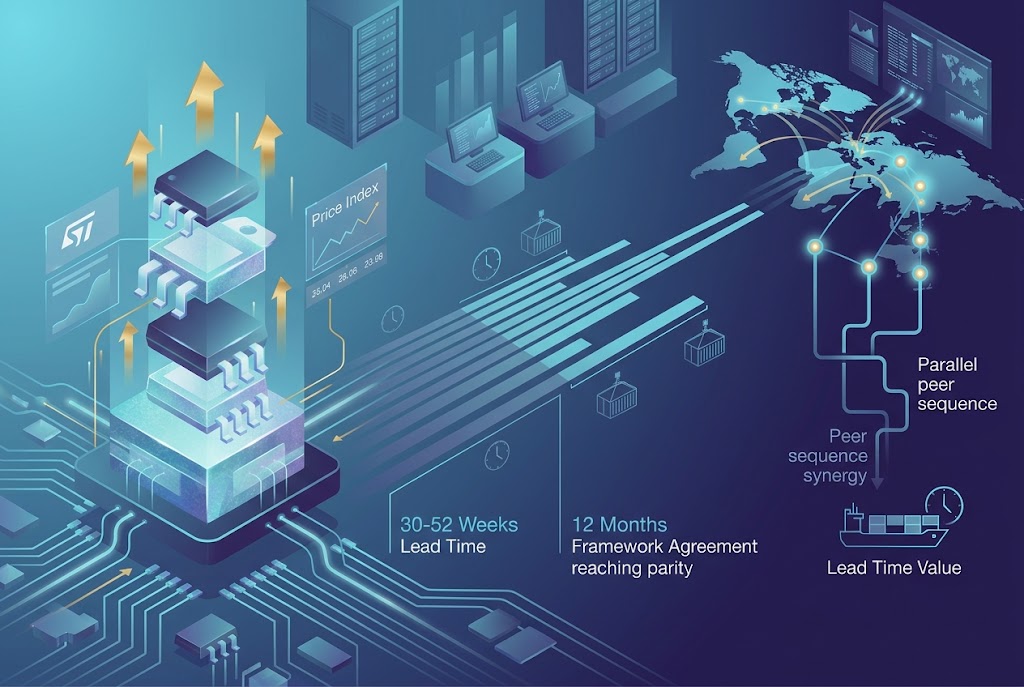
Lead time figures from the same TrendForce report: power devices generally above 30 weeks, with some categories at 52 weeks.
Fifty-two weeks means parts ordered today deliver in August 2027.
That number changes more than the stocking rhythm. It changes the boundary of contractual force. Most annual framework agreements cover 12 months, so a 52-week lead time is now as long as the agreement itself. Delivery commitments resting on a framework agreement lack support under this structure, because the agreement can expire while the parts are still in transit.
Lead time and price reinforce one another here. A long order queue gives the supplier room to reset pricing, and the reset price does not shorten the queue. These are not sequential cause and effect; they are two readings of the same supply-demand state.
4. This is not an ST-specific event
Placing this round back into the peer sequence:
- TI: five adjustments in twelve months.
- NXP: effective August 1, automotive and industrial MCUs up 5–15%.
- Infineon: two rounds this year, with July lifting AI server power and automotive power devices 10–20%.
- onsemi: effective April 1, covering selected categories.
- STMicroelectronics: August 23, third round of the year.
Five suppliers, spanning analog, power, MCU and RF front-end.
What this sequence changes is the premise behind substitution. Switching supplier to avoid an increase works when a single supplier moves. It does not work under category-wide repricing. Second-source value in this cycle returns to lead time and availability rather than price.
5. Verifiable positions on the sourcing side
The pricing basis on open orders warrants reconciliation with distribution within the week. The August 23 effective date has split the order book in two, and locked and unlocked lines are handled differently.
Placing 1H27 ST power device volume before quarter-end matches the 30–52 week lead time structure.
Quote validity set at four weeks or less matches the roughly two-month supplier cadence. Quotes longer than that carry exposure to being cut through inside the next adjustment window.
Automotive and industrial BOM quotations based on 2025 pricing have lost validity, and cost recalculation needs one pass within the quarter.
6. This tightness has no AI linkage
One confusion is easy to fall into. The 2026 shortage narrative is dominated by AI memory, which invites putting every category's tightness on the same curve.
Analog and power devices are not on that curve. This round is driven by capacity structure and cost pass-through, with no direct link to HBM allocation or DDR5 contract pricing.
The consequence is that relief timing is not synchronised either. Expectations of memory-cycle loosening in 2H27 do not extend to automotive MCUs and power devices. The read that tightness in these categories runs at least into mid-2027 is unchanged after this round.
Within a single BOM, memory and analog-power require two independent stocking logics and two independent quote-validity windows. Placing them under one assumption is the most common scheduling error in this cycle.