Published on: June 26, 2026
TSMC Just Hiked Every Node Below 7nm by 5–10% — But the Spot-Channel Signal Is in the Mature Capacity Being Pulled Away, Not the Leading Edge
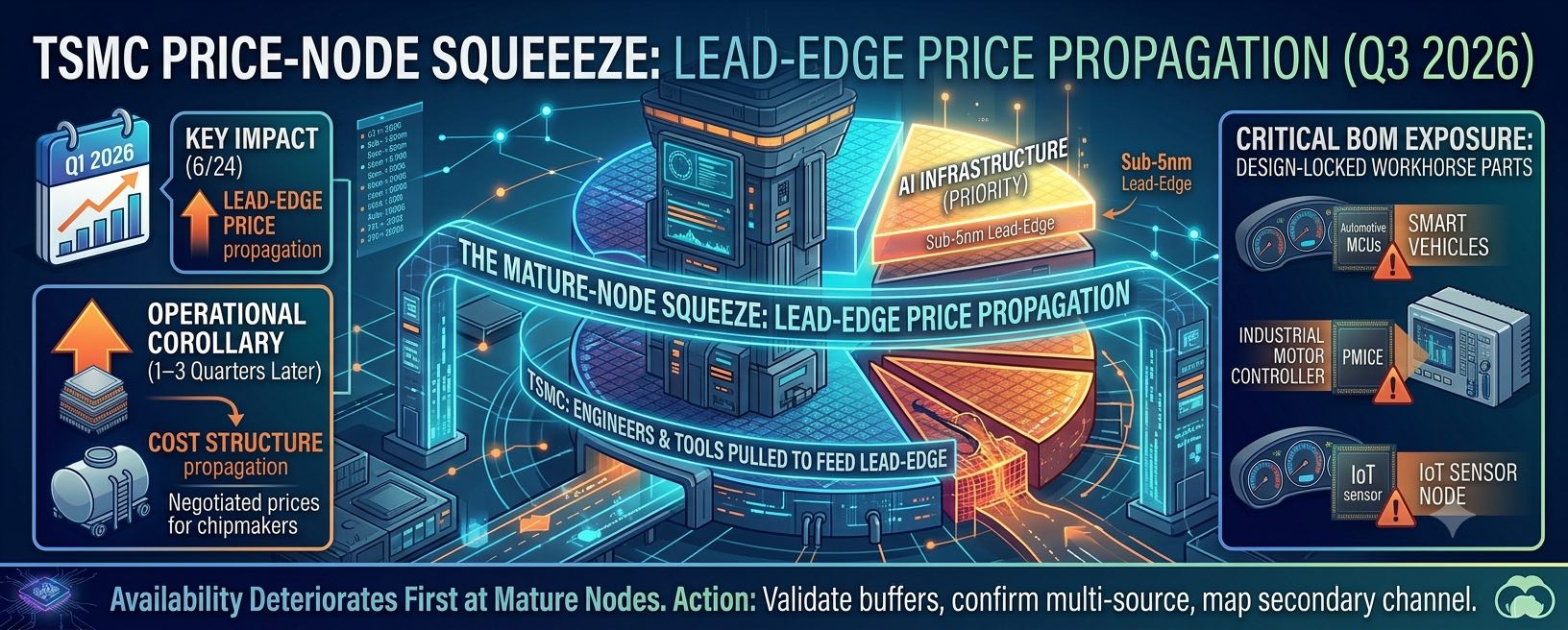
On June 24 TSMC told customers it is raising prices 5–10% across all advanced nodes, 7nm and down. Spot buyers don't touch N2 wafers, so the headline number isn't your trade. The real signal is on the other side: TSMC is moving people and tools to sub-5nm, and mature-node parts are about to get tight. Here's where the cut lands and which parts to watch.
On June 24, TSMC sent customers a notice: 7nm and below, every advanced node, up 5–10%.
Read the word "every."
This isn't just the bleeding edge — N2, N3. It's N7, N5, N4 too, nodes that have been running for years. The hike covers roughly 75% of TSMC's wafer revenue.
The reason is simple. AI/HPC has eaten the capacity. N2 volume production only started at the end of 2025 and is already booked through the end of 2026. Capex is high, EUV is expensive. When supply is short, price holds. NVIDIA, AMD, Apple, Qualcomm, MediaTek — all queuing on the leading edge. Nobody escapes.
At this point a lot of spot traders reflex straight to: "Prices up again, time to stock."
Stop. Think about where the cut actually lands first.
It lands in foundry. It lands inside the cost structure of an NVIDIA GPU. Spot buyers don't buy 2nm wafers, and they don't buy freshly taped-out GPUs. N2 up 50%, 3nm reportedly up to 15% in 2H — those numbers don't touch the reels in your warehouse. They will flow down, but over two or three quarters, and they show up first in the BOM of new silicon, not in tomorrow's spot quote.
The signal that matters is in the other half of the story.
To feed sub-5nm, TSMC is shifting tools and headcount off mature nodes. The result: mature-node capacity (28/40/55/65nm) is tightening for the parts that aren't on the priority list — the non-core customers.
That is the spot-channel's plate.
What runs on mature nodes? Automotive MCUs, industrial PMICs, a long tail of analog, power management, legacy interface/logic, sensor front-ends. Exactly the parts an end factory uses by the thousand, carries deep on the BOM, and can lose a single line to.
The chain, step by step:
- Leading-edge prices up → fabs steer wafer allocation to high-margin AI/HPC first
- Mature nodes lose tools and people → non-core customers slide down the schedule
- Mature-part lead times stretch → maker/distributor quotes firm, allocation tightens
- An end customer suddenly short a mature part → urgent sourcing spills into spot and secondary
That last link is the window for brokers and spot.
So the move isn't to blindly stock "the parts that went up." Watch two buckets:
Bucket one — mature-node-heavy product lines. Automotive MCU, industrial PMIC, legacy interface logic, analog front-ends. When lead times on these start stretching and makers get picky on DC/lot codes, that's the early sign capacity is being squeezed out. If you're holding this stuff with fresh, traceable lots, don't dump it.
Bucket two — the leading edge itself: don't chase it. GPUs, AI accelerators, the newest phone SoCs. The hike is real, but it isn't your pool. Watch it; don't treat it as a reason to stock.
A colder note: this hike isn't a one-off. It's a multi-year program running from 2026 through 2029, flagged since late last year. So "mature getting squeezed out" isn't a story that started this week — it's a story this week's official hike confirmed again. It's structural, not a pulse.
For spot, it comes down to one line: the real arbitrage isn't in the sharpest cut, it's in the mature parts shoved aside by it — the ones no one is rushing to serve. Whoever locks those lines and lot codes before lead times blow out is standing on the right side of the next urgent-sourcing wave.
Don't drool over the N2 quote. Watch the mature parts you can actually carry, the ones the end factory will actually panic for.