Published on: July 20, 2026
TSMC Is Putting Advanced Packaging in Arizona — and Not One Lead Time on Your Desk Gets Shorter Because of It
On July 16 TSMC released 2Q26 results and a $100B Arizona expansion on the same day. The earnings looked excellent. The part that actually carries information for spot buyers is buried in the investment announcement: two advanced packaging facilities, the first TSMC has ever committed outside Taiwan. That is an official confirmation of what has been constraining this cycle — and it is not wafers.
On July 16, TSMC put out two things on the same day.
The first was 2Q26 results. Revenue of $40.20B, up 33.7% year over year and 12.0% sequentially. Gross margin 67.7%. Operating margin 60.3%. Nodes at 7nm and below accounted for 77% of wafer revenue.
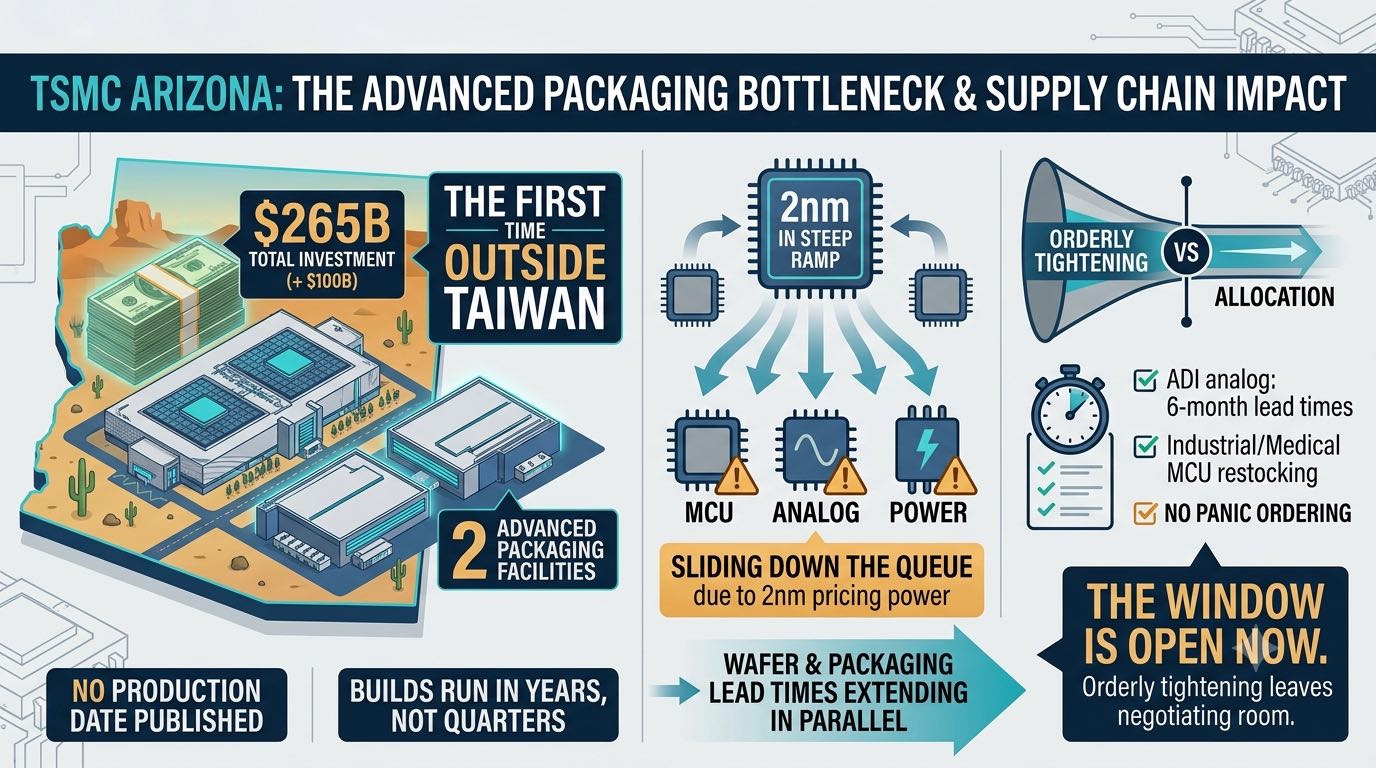
The second was an additional $100B for Arizona, funding four more fabs at 2nm and beyond. Total commitment to the state now stands at $265B, covering 10 fabs, two advanced packaging facilities and an R&D centre.
The earnings are the headline. For anyone trading physical parts, the information sits in three words in the second announcement: two packaging facilities.
Why those three words matter
This is the first time TSMC has committed advanced packaging capacity outside Taiwan.
Until now, essentially all of it has been on the island. Which means every AI accelerator using TSMC's most advanced packaging has had to clear a single geographic chokepoint. Earthquake, typhoon, power rationing, geopolitics — all of that risk concentrated on one production base.
TSMC is now spending its own money to move part of that elsewhere.
When a company commits capital at this scale to a specific problem, that problem is usually a constraint rather than a comfort.
The read is straightforward: packaging is the bottleneck, and this is the official confirmation.
The announcement will not shorten your lead times by a single day
Now the cold water.
No production timeline was given for either packaging facility. TSMC's Arizona projects have historically run multi-year from groundbreaking to volume, not multi-quarter.
So the practical effect on orders currently on your desk is zero.
Meanwhile, here is what actually moved this week. Digitimes commentary on July 16 reported that cloud AI demand is squeezing capacity, with wafer and packaging lead times extending in parallel, and that ADI has notified customers of six-month lead times on some analog products.
A long-dated capacity announcement on one side, extending back-end lead times on the other. Both are true simultaneously, and both point the same direction.
Three things worth doing this week
One: hold anything packaging-adjacent.
FCBGA, SiP and large-format substrate-related finished and semi-finished stock is worth more held than moved right now. TSMC just spent $100B telling you this segment is tight. There is no reason to sell ahead of tightness.
Two: have an answer ready for the price-pressure conversation.
Customers will cite US fab construction to push price down this week. The response is simple. No production date was published. TSMC's Arizona builds run in years. And ADI's analog lead times went to six months this week. Long-dated capacity plans and current delivery are two different conversations; do not let them be merged into one.
Three: shorten quote validity on mature-node parts.
TSMC guided 3Q26 to $44.6B–$45.8B, another 11–14% sequential step, with CFO Wendell Huang citing the steep ramp of 2nm.
Leading edge is consuming capex and back-end capacity at the same time. MCU, analog and power expansion moves further down the queue as a direct consequence.
That shifts the negotiating environment on mature-node excess inventory toward the seller. Pull quote validity from seven days to three to five, and stop issuing long-dated quotes.
An easy detail to miss
By end-market platform, high performance computing — which includes AI accelerators — was 66% of TSMC's 2Q26 revenue, with smartphones at 22%.
Then look at the wider chain. Digitimes' monthly tracker on July 14 showed all 13 tracked Taiwan sub-sectors posting year-over-year revenue growth in June, with aggregate foundry revenue at $15.13B, up 54%.
This is not one segment pulling in inventory. This is the whole chain moving up together.
And when a whole chain moves up together, the first thing to jam is never the most expensive step. It is the least elastic one.
This cycle, that step is packaging.
Closing
The number worth remembering is not $265B. It is where the money points.
For several years the industry has treated "shortage" as shorthand for insufficient wafer capacity. That is not what this cycle is. Wafer capacity is expanding aggressively; 2nm is already in steep ramp. What is jammed is the step that turns a wafer into a usable package — a step with longer build cycles, heavier geographic concentration and fewer substitutes than wafer fabrication.
Spending $100B is, in effect, an admission of exactly that.
When that money becomes capacity, the announcement does not say. Until it does, lead times only get longer.