Published on: July 17, 2026
The Price Wave Just Left the Memory Aisle: Analog, MCU, Power and Passives Are All Repricing — and the "Cheap" Half of Your BOM Isn't Cheap Anymore
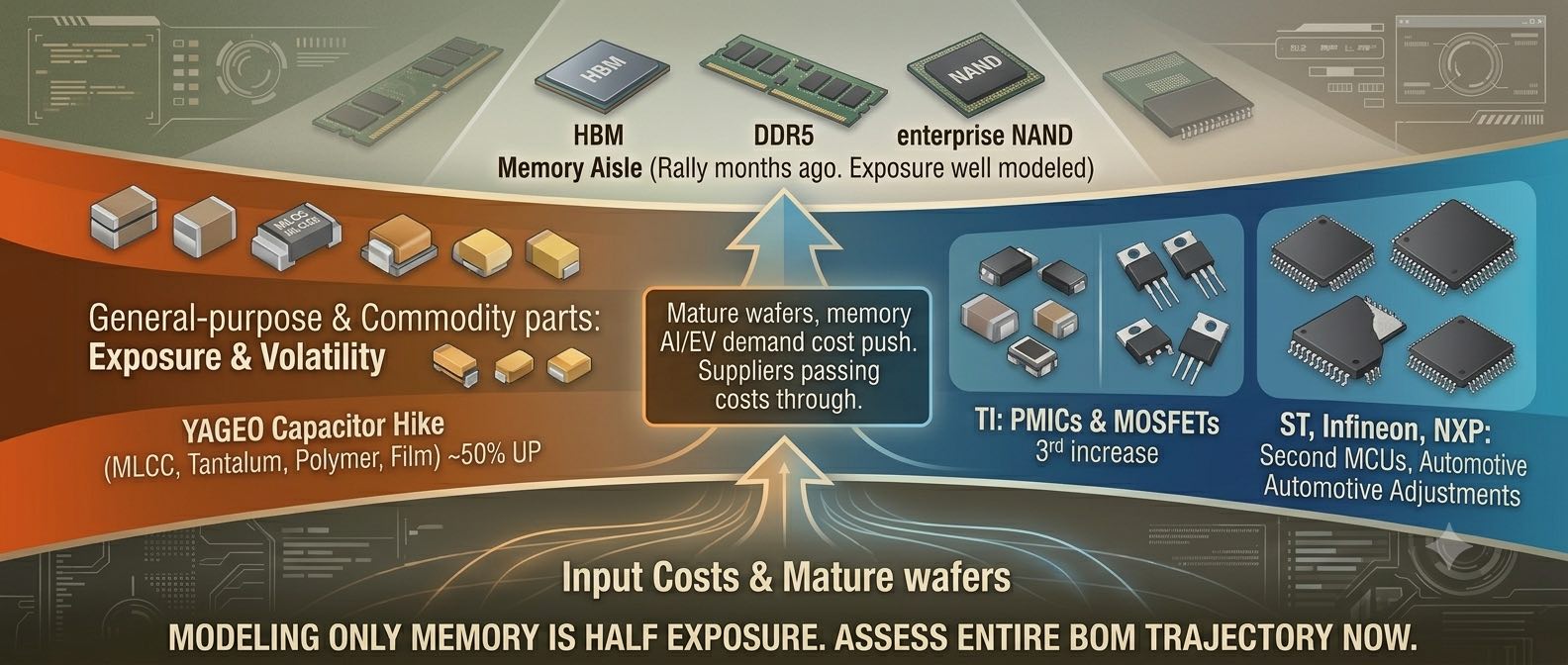
For six months the market watched memory. The real shift in July is that the price wave has left the memory aisle. YAGEO's broadest capacitor hike in years, TI's third increase of 2026, second rounds from ST/Infineon/NXP, and general-purpose MLCC now moving 6-13%. The parts everyone treated as jellybeans are now the front line of repricing.
For most of the last three quarters, attention sat almost entirely on memory. HBM, DDR5, enterprise NAND — the glamour parts, the easy story.
July is worth reading from a different angle. The news is not that memory went up again. It is that the price wave finally left the memory aisle.
Start with passives. From July 1, YAGEO opened its broadest capacitor adjustment in years — MLCC, aluminum electrolytic, tantalum, polymer, film, supercapacitors, the whole line. List prices moved up around 50%, with the spot market steeper. This is not one case size or one dielectric getting tight. It is the entire capacitor line moving together.
The part that should get a buyer's attention is the general-purpose grade. Broad hikes usually start at the high end and automotive parts, with consumer and industrial MLCC lagging. Not this time — from July, general-purpose MLCC entered a 6-13% increase band. When the cheap parts move first, the driver is not a single demand spike. It is cost pushing up through the whole stack.
Analog and MCU are moving in step. TI announced its third increase of 2026, effective July 1, reaching high-volume power parts like PMICs and MOSFETs, with magnitude varying by part and process. ST's second MCU adjustment took effect June 28. Infineon's second, July 1. NXP's second round, automotive-led, from June 1. Even AMD added roughly 10% to GDDR kits for its AIB partners.
Put it together and the logic is clear:
- Mature-node wafers are rising. Foundries like TSMC and SMIC are lifting mature-node pricing alongside copper, silver and silicon, raising the cost floor under MCU, analog and power.
- Memory cost is bleeding into MCU. MCUs with on-chip memory are hit first — a concrete path by which the memory super-cycle spills into non-memory parts.
- AI plus new-energy demand gives makers the confidence to push price.
For a spot buyer, a few direct reads:
Part-type value is being reordered. General MLCC, mature analog and MOSFETs that used to sit on the shelf with no takers now have factory list moving up, which opens repricing room for secondary and idle stock. Stop quoting last year's mental price.
Quote windows are shrinking. At three hikes a year, distributor and spot quote validity is compressing. Do not default to a one-month lock on non-memory parts.
Watch NCNR and allocation. As price rises, factory allocation and NCNR terms tighten, and spot premium on tight part numbers reacts before official list.
The sensitive point in BOM cost has moved. Building an industrial or automotive BOM, teams used to cost around the MCU and the main device. Now the passive and power lines — the "don't need to worry about it" section — are the fastest movers.
The memory story has been running for two quarters. The new information in this wave is the other half of the invoice — the parts long treated as cheap, stable, always available — moving up together. If you are holding general parts, do not clear them at the old price. If you are quoting a BOM, rerun the passive and power lines first.