Published on: May 26, 2026
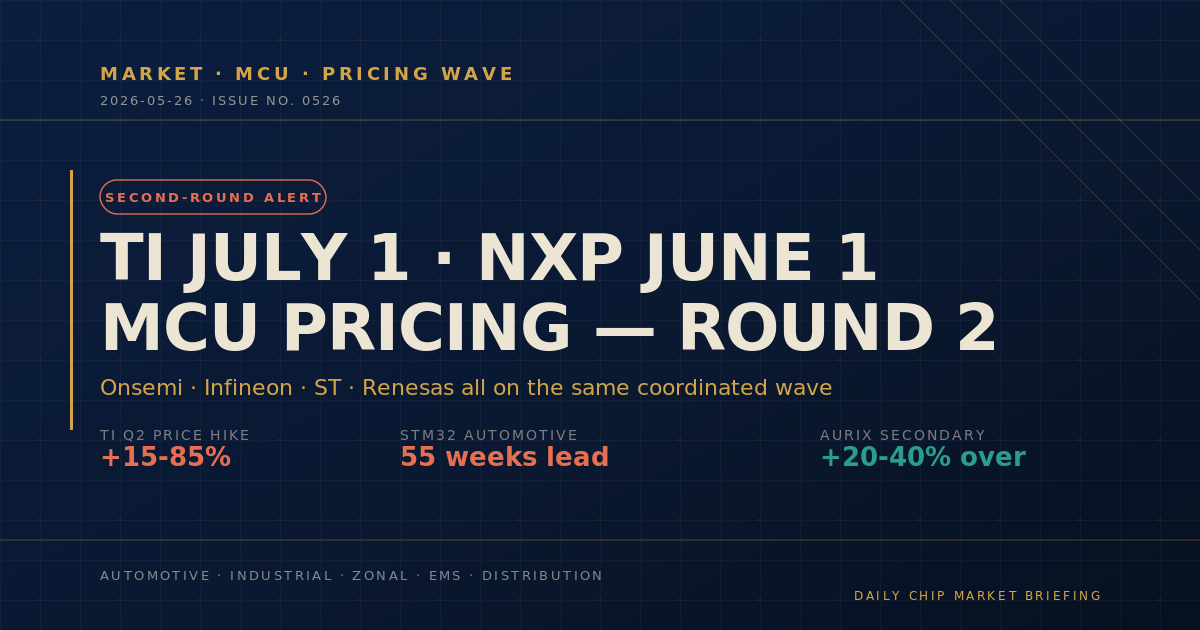
TI on July 1, NXP on June 1 — the same-year second price wave is here, and the industrial / automotive MCU window for brokers is opening, not closing
TI fired the second round of 2026 price hikes for July 1. NXP follows on June 1. Onsemi already raised on April 1. Infineon's April 1 increase is now six weeks in. Layer on STM32 TSX at 55 weeks and Renesas auto-grade at 20-45 weeks, and the OEM question is no longer how much it will cost but whether one last order can land before the next reset. Here is how brokers should be reading and pricing this.
The 2026 MCU pricing cycle does not look like 2024 or 2025. Same-year, same-vendor second increases — at TI, NXP, Onsemi, Infineon, ST — are now stacking on top of legacy-process lead times that already ran 20 to 55 weeks. The OEM-side reaction is predictable: tighten safety orders, pull qualifications forward, and freeze the bill of materials. The broker-side reaction is less obvious, and it is where 2026 H2 margin actually shows up.
Lining up the vendor calendar
- TI announced the first 2026 round on April 1 — 15 to 85 percent across analog and embedded, depending on line. A May 7 internal notice signals a second round effective July 1 on all new orders and shipments.
- NXP raised on April 1 on selected lines, then issued a second-round letter for June 1, citing raw material, energy, labour and logistics pressure.
- Onsemi raised on April 1. May earnings calls confirmed the company is pricing to push gross margin into the 38 to 40 percent range.
- Infineon's April 1 increase is now six weeks in. AURIX, PSoC and selected industrial MCU lines are showing 5-12 percent channel ask-price increases, with secondary-market AURIX TC397 and TC4x running 20-40 percent over official.
Lining up the lead times
- ST: TSX series and automotive-grade STM32 quoted at 55 weeks, the longest in the major-vendor set. China-manufactured STM32 entered volume production on March 26, but allocation is locked to long-term customers; the secondary channel does not see this supply.
- TI: 20-40 weeks across MCU portfolio, with the highest-demand analog and embedded SKUs at the long end.
- Renesas: 20-45 weeks, with automotive-grade RH850 at the long end. The new 28 nm RH850/U2C launched March 6 — four cores at 320 MHz, dual lockstep, 8 MB flash, ASIL D — targets zonal vehicle control and will eventually pressure legacy RH850/U2A and U2B inventory value.
- Infineon: AURIX 20-30 weeks.
- NXP: S32 12-20 weeks, the most accessible of the major vendors, but distribution inventory is thin.
- AI-edge MCU new launches across vendors: 16-24 weeks at product launch, an unusual condition.
Where the broker window actually is
It is not "wait for the price to peak and then sell high." Customer procurement budgets are hard caps; if a broker price overshoots, the buyer routes around to authorised distribution under NCNR and the broker loses the trade entirely. The window is shorter and more disciplined than that.
Window 1: the last week before each vendor's effective date. TI inventory should be tagged "pre-April-1 build" versus "post-April-1 build" at the SKU level. OPA, TPS and MSP430 lines are where customer price sensitivity is sharpest, and the May-to-late-June window is when "pre-second-increase" stock carries its peak commercial value. The customer logic is straightforward: paying eight percent over current market today is cheaper than paying 15-25 percent over current market after July 1. NXP follows the same logic on a one-month earlier clock for S32K, Kinetis and i.MX RT lines.
Window 2: STM32 legacy date-code premium. ST's China-manufactured STM32 volume production is a long-term concern only. Near-term it does not flood the secondary market because the volume is allocated to long-term customers. PPAP-sensitive industrial buyers — power conversion, industrial control, security — still prefer European or Moroccan date codes and will pay for them. Sort STM32 inventory by fab and date code, run a separate tier for PPAP-sensitive customers, and price the broader secondary channel at the mid tier.
Window 3: AURIX secondary-market premium. Infineon AURIX TC397 and TC4x running 20-40 percent over official in the secondary market is real demand from Tier-2 automotive buyers, not speculative inflation. Do not undersell. Do not stockpile either: AURIX secondary pricing is sensitive to any quarterly relaxation in Infineon's official allocation, and a Q3 loosening will compress secondary premium quickly. Quote today, 48 hours valid, on every PO line.
Window 4: MLCC pairing. OEM RFQs now bundle MCU and MLCC in the same BOM ask. Taiyo Yuden raised low-mid cap and selected automotive MLCC by 6-13 percent starting in May. Samsung Electro-Mechanics is preparing 5-10 percent. Murata raised on April 1. Spot pricing on high-grade X7R and X8R parts has moved roughly 20 percent year-to-date. Pairing MCU quotes with matched MLCC quotes raises conversion materially over MCU-only quoting.
What the spot data looks like
- TI OPA and TPS family secondary ask prices are up 6-12 percent over the last four weeks, with a 12-18 percent step expected in late June ahead of July 1.
- STM32F4 and F7 mainline densities are climbing steadily. Industrial-buyer RFQs explicitly searching for "in-stock, lockable lot" are up 30-40 percent versus the trailing quarter.
- AURIX TC397 secondary premium has stabilised at 25-35 percent. TC4x new-build is almost entirely authorised-distribution flow; secondary inventory is rare.
- 10 µF X7R MLCC at 0805 and 1206 form factors is up 12-18 percent since April. AI server bill-of-materials buyers and automotive Tier-2 buyers are the dominant inbound RFQ source.
Playbook for the next 60 days
For brokers and stocking distributors:
- Tag every TI, NXP, ST, Infineon line item as pre- or post-increase build. Price separately. Be ready to defend the gap.
- Make June the highest-velocity outbound month of the year for pre-July-1 TI inventory. Do not hoard fresh post-July-1 incoming.
- Run AURIX, RH850 and high-end S32 on a "live quote, 48-hour validity" basis. No long-term payment terms on premium SKUs in this regime.
- Bundle MLCC and discrete passives with every MCU RFQ. Conversion rate is materially higher than MCU-only.
For OEM and EMS buyers reading this:
- Place safety orders on critical SKUs before each vendor's effective date.
- Long-lead-time SKUs (STM32 TSX, automotive Renesas, AI-edge new MCU) require NCNR commitments. Plan budget accordingly.
- The RH850/U2C 28 nm migration question is a 2027 platform decision, not a 2026 sourcing decision. Hold legacy U2A and U2B inventory at planned depth through 2026; do not pre-commit until the next vehicle-control platform spec freezes.
Reading the cycle
The headline is "two price increases in one year". The structural signal is that vendors have moved from annual contract pricing to rolling cost-plus pricing on legacy-process MCUs, and OEM procurement has not adjusted its planning cadence to match. The mismatch between vendor pricing velocity and OEM budget velocity is the entire commercial opportunity for disciplined secondary-channel brokers in 2026 H2. The window is not one big window — it is a series of four-to-six-week windows aligned to each vendor's effective dates. Hit them, and H2 margin will be visibly better than 2025. Miss them, and the same conditions punish you twice.