Published on: June 5, 2026
China Tightens Its Grip on SiC: $500 Substrates, the 8-Inch Transition, and What 800V AI Data Centers Mean for Power Sourcing
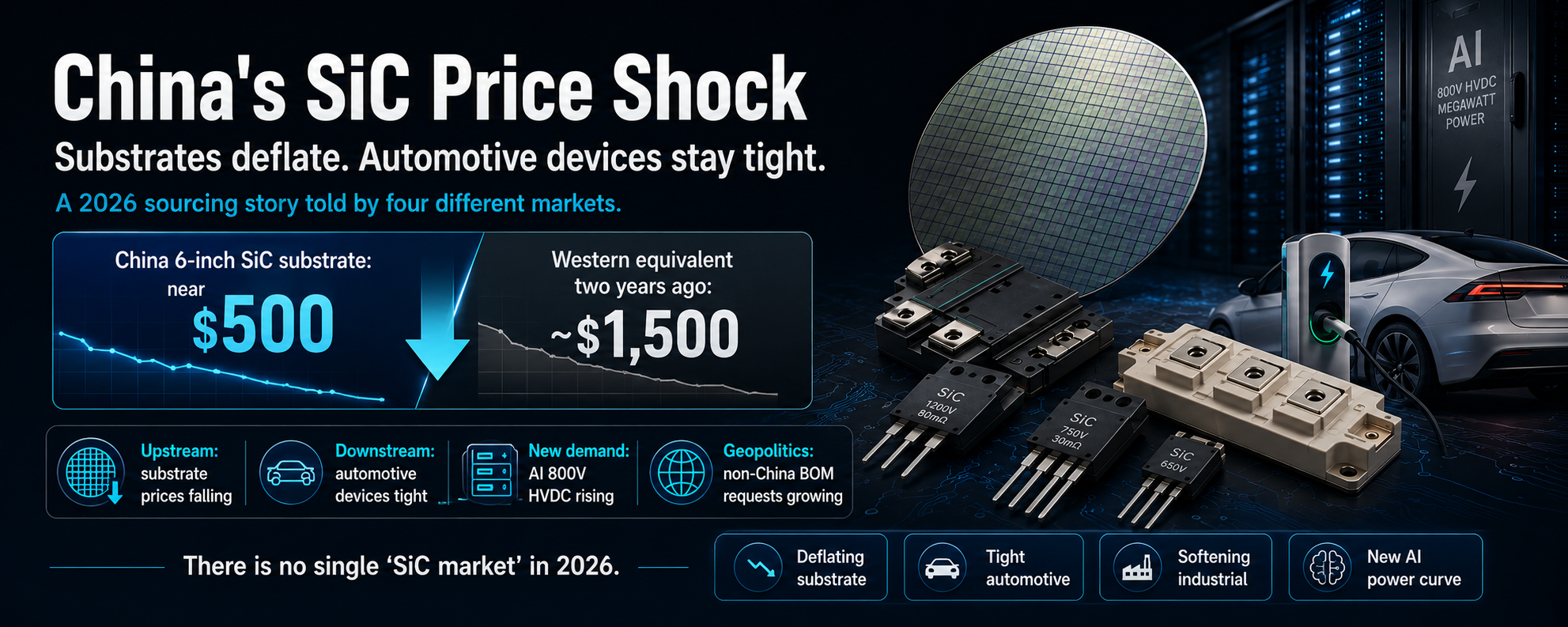
DigiTimes reported on June 4 that China is consolidating control over the SiC supply chain just as the industry shifts to 8-inch wafers. Substrate prices have crashed to around $500 a piece while automotive-grade SiC MOSFETs stay tight, and 800V HVDC AI data centers are opening a second demand lane. Here is what the split market means for buyers and brokers.
The news first
On June 4, DigiTimes ran an exclusive: as the SiC industry shifts from 6-inch to 8-inch wafers, China is tightening its grip on the supply chain. The backdrop is Computex 2026, where AI data center infrastructure dominated the floor — and silicon carbide, with its ability to handle high voltage and heavy current, has become a core enabler of the 800V high-voltage DC (HVDC) power architectures everyone is now designing around.
The one-line summary: the upstream is deflating, the downstream is still tight in the places that matter, and a brand-new demand pillar just showed up.
Upstream: the substrate price war hit the floor
- Chinese 6-inch SiC substrates now quote as low as roughly $500 a piece. Two years ago, Wolfspeed charged about $1,500 for the equivalent.
- TrendForce flagged SiC prices falling nearly 30% a year back in 2024 — and the slide never really stopped.
- SICC, TanKeBlue and the rest of the Chinese substrate camp are fighting the 6-inch price war while scaling 8-inch capacity, with 12-inch samples already on display.
- Subsidies plus brutal internal competition mean the bulk of new global substrate capacity sits in China. Meanwhile Wolfspeed emerged from its 2025 Chapter 11 restructuring with the Western substrate camp effectively consolidating, not expanding.
Downstream: a completely different story
Cheap substrates do not equal cheap devices. This is where end customers most often get it wrong.
- Automotive-grade SiC MOSFETs for traction inverters and OBCs remain structurally tight. onsemi's SiC MOSFETs and diodes for EV traction are still flagged as constrained product families in 2026.
- Western IDM power pricing is still moving up, not down — a second round of list-price increases lands this summer, with power discretes squarely on the list.
- The qualification wall is real: a $500 substrate still has to become an AEC-Q101-qualified device, and that takes production-line credentials, yield learning, and 12-plus months nobody can shortcut.
The new variable: 800V HVDC AI data centers
This is the part worth watching most closely:
- The NVIDIA-led 800V HVDC architecture pushes AI rack power from tens of kilowatts toward megawatt scale, and SiC content in rectification and DC-DC stages rises with it.
- SiC demand is shifting from a single-pillar story (EV) to a dual-pillar one (EV + AI data center). Where EV growth disappointed, data center build-outs are filling the gap.
- SiC getting the spotlight at Computex 2026 wasn't nostalgia — the demand structure genuinely changed.
What buyers should actually do
- Don't bet on auto-grade SiC MOSFET prices falling. Lock H2 allocation for traction and OBC parts; the makers are still in a hiking cycle.
- Industrial, solar and ESS sockets can afford to wait. Substrate deflation reaches second-tier and Chinese device brands first — that's where H2 pricing gets interesting.
- Run China-brand qualification now, but don't overestimate the speed. BYD Semiconductor, StarPower and Basic Semiconductor price aggressively, but 12–18 month qualification cycles mean you carry the inventory risk in the meantime.
- Keep one eye on geopolitics. Gallium and germanium export controls set the precedent; SiC substrate capacity concentrating in China is a new single point of failure. Western customers are already asking for non-China BOM options — for brokers, that's an opportunity, not a headache.
The takeaway
This SiC market is three stories stacked on top of each other: upstream deflation, downstream divergence, and a demand handover from EV to AI infrastructure. The substrate price war decides who is still standing in two years; device tightness decides who holds pricing power this half. For traders, the margin was never in the average price — it's in the dislocations. Tight automotive, loose industrial, accelerating China substitution, Western de-risking: every gap in that list is a trade.
Sources: DigiTimes, TrendForce, Semiconductor Today