Published on: July 13, 2026
Chip Stocks Just Gave Back 10% in Two Sessions — and Not a Single Part Got Easier to Buy
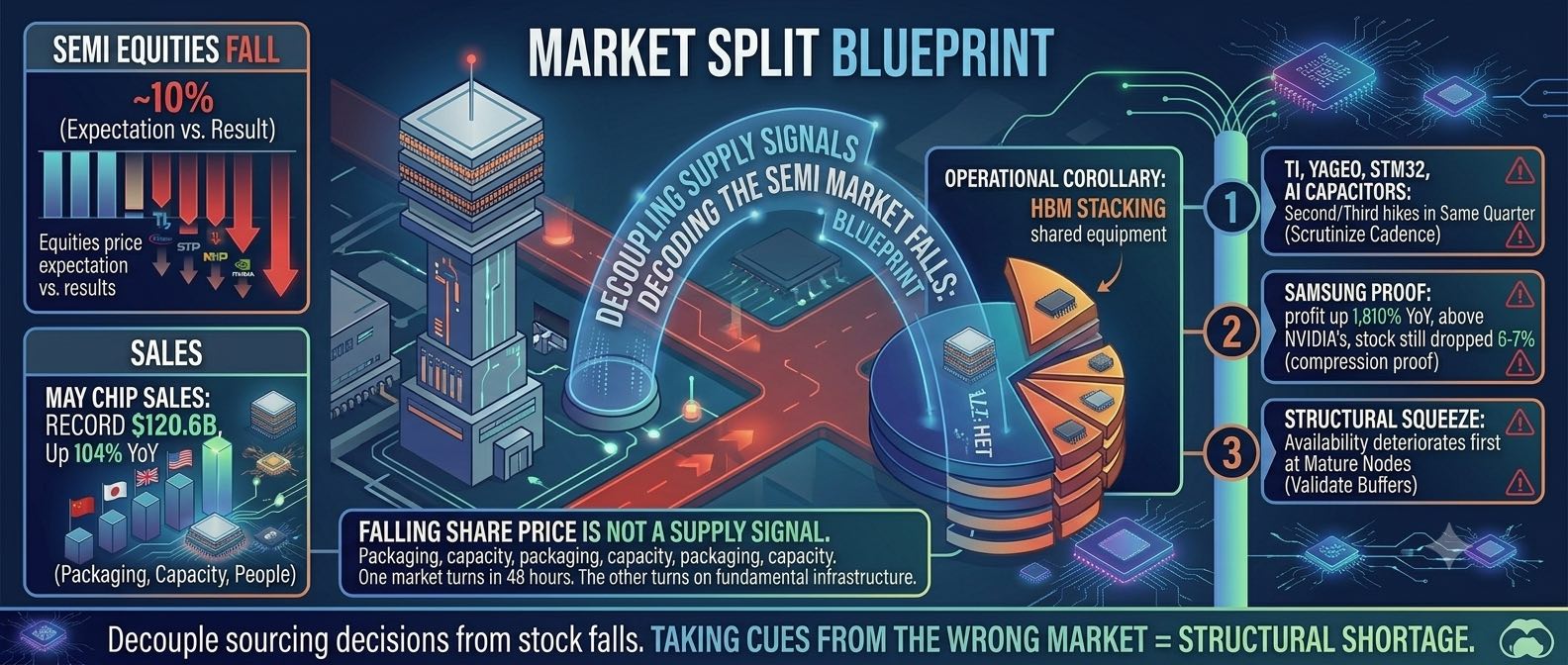
Semiconductor equities fell 5.4% and then 4.5% in back-to-back sessions this week. In the same week, SIA reported record May global chip sales of $120.6B — up 104% year over year — and Samsung guided Q2 operating profit to KRW 89.4T, an 18-fold jump. The tape went down. The parts stayed tight. Both are true, and they are not in conflict.
Three numbers from this week. Put them side by side.
One: SIA/WSTS reported May global semiconductor sales of $120.6B. Up 9.2% from April, up 104.1% year over year, the 15th consecutive monthly increase, and the highest single month on record. Regionally, YoY: Americas +132.2%, Asia Pacific +118.9%, China +88.8%, Europe +60.7%.
Two: Samsung Electronics guided Q2 on 7 July. Revenue KRW 171T, +129.3% YoY. Operating profit KRW 89.4T, +1,810.3% YoY. A record for the third straight quarter, and a quarterly operating profit that came in above NVIDIA's. Memory alone is estimated to have delivered around KRW 90T of that.
Three: the tape. SMH closed its best first half ever at +82%, then dropped 5.4% and another 4.5% in consecutive sessions as money rotated out of AI names.
Line those up and something looks broken. Record sales, a market leader printing an 18x profit increase — and the stocks fall?
They are not describing the same thing.
Equities trade the expectations gap. They do not trade availability.
The Samsung detail is the cleanest illustration you will get.
Operating profit KRW 89.4T. Up 1,810% year over year. A number that would have been unimaginable eighteen months ago. And the stock fell 6–7% on the day.
Why? Revenue came in at KRW 171T against a consensus of KRW 172.18T. A miss of roughly one trillion won — less than 1%.
Less than 1% below expectations, and the stock drops 7%.
That is the entire logic of the secondary market. It does not ask whether parts are obtainable. It asks whether the print was better or worse than what was already priced in. SMH was up 82% in six months. Several quarters of good news had already been pulled forward into the multiple. When you are priced that richly, a marginal miss compresses the multiple. It does not tell you anything about the physical market.
What sold off this week was valuation. Not supply.
Did anything actually loosen? No.
Samsung's own numbers argue the opposite. You do not print KRW 90T of memory operating profit on volume. You print it on price. DRAM and NAND are still climbing, and there is no easing at all on the server side.
The same pattern runs through analog and power. TI began its third increase of the year on 1 July, covering core lines including PMICs and MOSFETs. Infineon's second took effect the same day. ST's second MCU adjustment landed 28 June. NXP's went effective 1 June.
Passives are harder still. YAGEO lifted official list prices across its entire capacitor portfolio by roughly 50% on 1 July — MLCC, aluminium electrolytic, tantalum, polymer aluminium, film, supercapacitors — and for the first time pushed the increase directly onto EMS and OEM accounts. Those direct accounts are about 55.4% of its revenue. The cushion that used to absorb this is gone.
Spot on high-end AI-server capacitors has moved as much as 10x inside a month.
Lead times have not moved either. ST is quoting 16–52 weeks across STM32 variants, automotive-grade at the long end. NXP i.MX7 and i.MX8 are pushing 30 weeks on back-end substrate and packaging allocation. Microchip wants 26 weeks of visibility.
None of that is new this week — it all took effect in late June and early July. But that is exactly the point. On the two days the stocks fell, your cost of goods did not move one cent.
And a typhoon put Taiwan back on the table
On 10 July, Typhoon Bavi shut Taiwan's financial markets. TSMC's June revenue release, scheduled for that day, slid to the afternoon of 13 July. Q2 earnings follow on the 16th.
One storm, and the most-watched monthly data point in the industry moves three days.
Follow that thread and it gets more interesting. TSMC's 2nm is sold out for the entire year. CoWoS advanced packaging capacity is, right now, 100% in Taiwan. Every AI accelerator using TSMC's most advanced packaging routes through a single geography.
The binding constraint was never wafer. It is advanced packaging. And advanced packaging currently has one address.
What this means if you actually buy parts
The mistake available to you this week is to treat "chips have peaked" as a reason to defer Q3 and Q4 coverage.
Don't. A peak in the share price and a peak in the shortage are different events, and this week separated them about as cleanly as they will ever be separated.
Concretely:
- POs already priced: execute on plan. Do not reopen them with your supplier because you saw red on a chart. You will not win the price back, and you may lose the slot.
- Customers will cite the stock tape to push your price down this week. Some of them will do it today. Put the SIA number in front of them: +104% YoY, 15 straight months up. End demand has not topped. The multiple did.
- Any BOM containing advanced packaging: carry 4–8 weeks of buffer. Open secondary-channel spot positions now as a hedge, not after a line stops.
- Consumer-grade is the one segment with real negotiating room this cycle. Give ground there if you must. Hold on server and automotive-grade.
- DDR4, low-density eMMC, LPDDR4 stay tight. On industrial and long-lifecycle programs, pull the last-time-buy window forward.
The item nobody shared
Bloomberg reported this week that the shortfall of high-skilled semiconductor workers in the US could reach 157,000 full-time roles by 2030, threatening construction and ramp schedules at fabs already under way.
Almost nobody passed that one around. It may be the most consequential story of the week for anything you are planning past 2027.
Every roadmap that assumes "new capacity arrives in 2027" assumes those fabs get built on time and ramp on time. The report says the people to build and run them do not exist yet.
Between the capacity on the slide deck and the capacity that ships, there are 157,000 unfilled jobs.
Close
This week produced an unusually clean sample: the financial market and the physical market visibly came apart.
The tape can shed 10% in two sessions while sales hit an all-time high, the leading supplier prints an 18x profit increase, capacitors go up 50%, and MCU lead times sit at 52 weeks.
They were never the same market. One trades the distance between reality and expectation, and can turn in forty-eight hours. The other trades whether the part is in a box today — and it turns on capacity, on packaging, and on 157,000 people who have not been hired.
Watch the wrong one, and you pay tuition.