Published on: June 15, 2026
DDR4 Now Costs More Than DDR5: A Practical Sourcing Playbook for the EOL Price Inversion
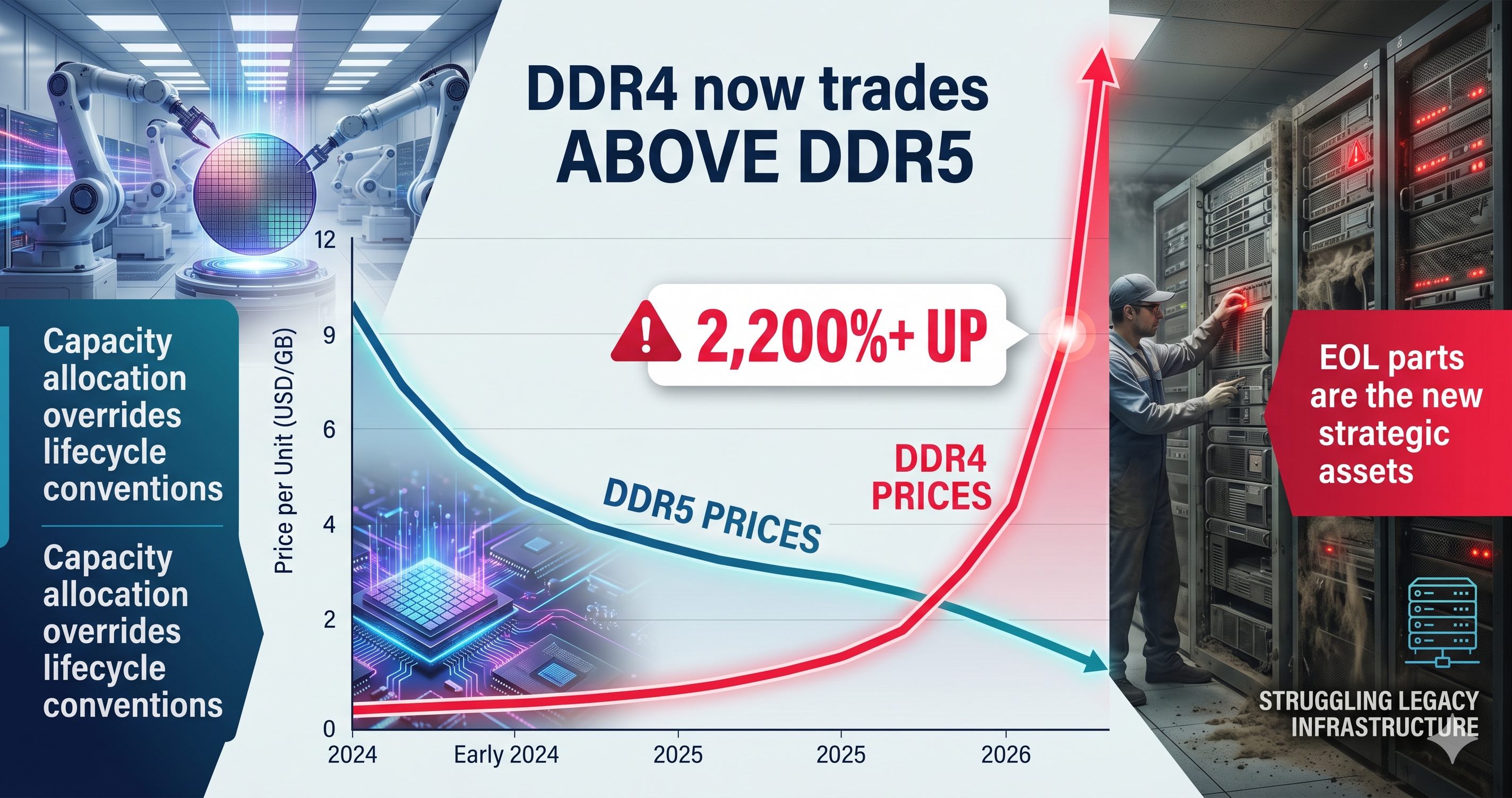
The big three memory makers are shifting DDR4 capacity to DDR5, LPDDR5X and HBM, and DDR4 last-time-buy windows are closing fast. The result is a price inversion — DDR4 spot now trades above DDR5, some SKUs are up 2,200%+ from 2024 lows, and a few makers are even restarting DDR4 lines. Here is what spot and channel buyers should actually do.
There is an old rule in this industry: when the new generation ships, the old one gets cheaper and clears out. DDR4 just broke that rule.
Right now DDR4 spot trades above comparable DDR5. Not by a hair — some DDR4 SKUs are up more than 2,200% from their 2024 lows. And, against all instinct, some makers are looking at that spread and reopening DDR4 lines they had already planned to retire.
The logic behind the inversion is simple:
- Wafer capacity at Samsung, SK Hynix and Micron is finite. Per wafer, DDR5, LPDDR5X and HBM all carry fatter margins than DDR4.
- So the makers do the obvious thing: move DDR4 capacity onto higher-margin parts, push DDR4 to EOL, and send last-time-buy (LTB) notices.
- But a large installed base still depends on DDR4 — industrial, networking, surveillance, medical, legacy server platforms. Those BOMs can't be redesigned overnight.
- Structurally shrinking supply plus sticky demand equals only one direction for price. That's the inversion.
For spot and channel buyers, this is a textbook EOL revaluation window. The things to do with the parts in front of you:
First, get a clean read on the DDR4 you're actually using. Which part numbers are still in the BOM, annual usage, whether the maker has already issued LTB, and how much of the window is left. Without that you can't plan the next move.
Second, run an immediate LTB assessment on EOL SKUs. Don't wait. Once the window closes you're buying from spot and channel stock at another step up. Lock what you can inside the maker's window.
Third, watch the spread; don't chase blindly. DDR4 trading above DDR5 is itself abnormal. If a part number can be replaced pin- and density-compatible by DDR5, re-cost a design-side swap — it may beat paying inflated DDR4 prices. This is a parts decision and a BOM decision at the same time.
Fourth, channel stock is worth real money right now. Whoever holds clean date codes, fresh DC, traceable DDR4 spot has leverage. DDR4 inventory that sat dead for two years may now be the part everyone wants. When you audit stock, pull DDR4 out and look at it separately.
Fifth, read the NCNR terms carefully. When prices are high, makers and franchise distributors mostly quote NCNR (non-cancellable, non-returnable). Nail down usage before you lock volume — don't end up sitting on parts you can't return just to lock a price.
One closing call: this inversion isn't short-term sentiment, it's structural capacity allocation. The consensus is no meaningful relief before end-2026, with some analysts pointing to 2027–2028. So this is not a “wait for the price to come back” part. It's a “lock what you should, plan the swap where you can” part. The fast hands are treating EOL DRAM as an asset; the slow ones will be chasing price on the spot market later.