Published on: July 8, 2026
The Memory Rally Just Split in Two: Why 3Q26 Rewards Spot Buyers Who Stop Treating "Memory" as One Trade
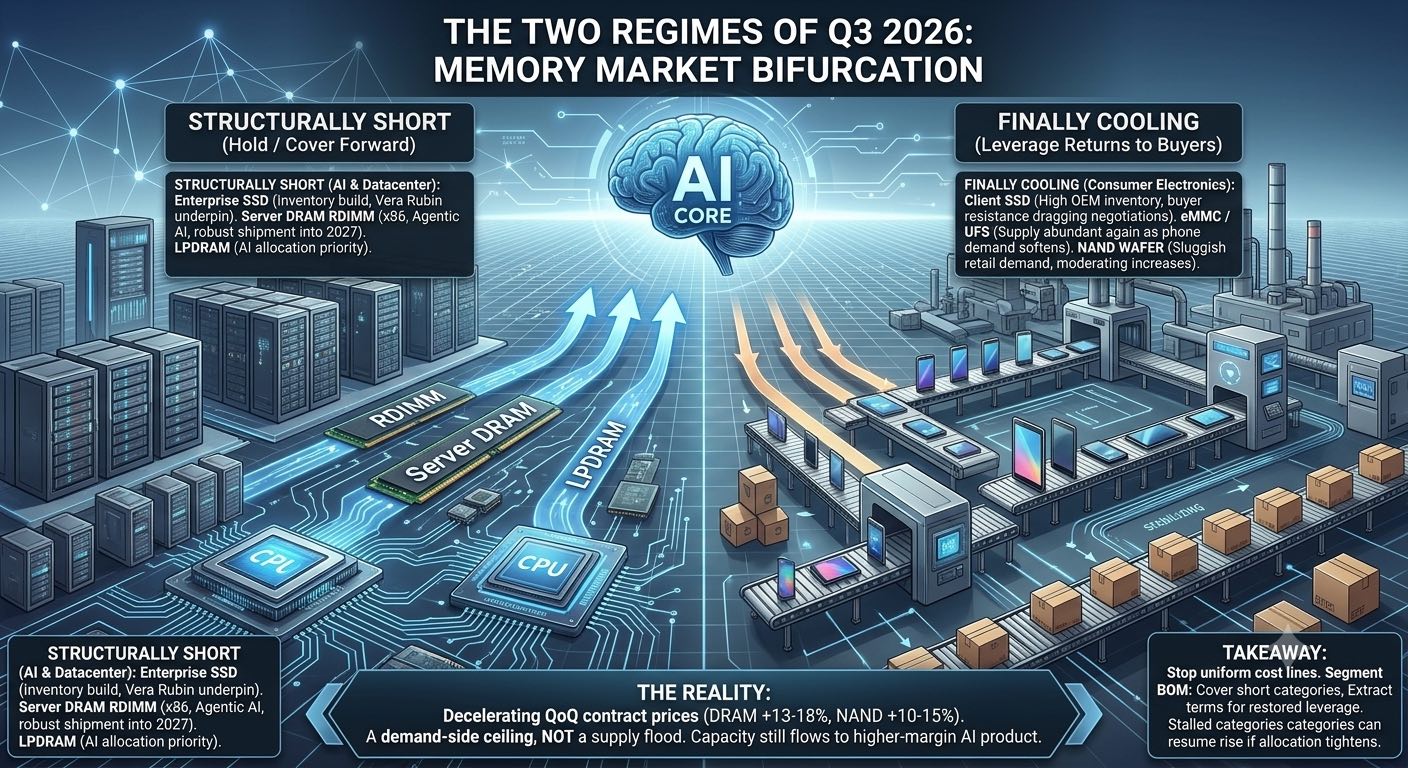
On July 3, TrendForce set the tone for 3Q26: conventional DRAM contract prices up 13-18% QoQ, NAND up 10-15%, both slower than prior quarters. The real signal is the split underneath: AI servers and enterprise SSD keep climbing while client SSD, eMMC/UFS and wafer hit the consumer affordability ceiling. The first quarter in a year worth trading in two halves.
For about a year, memory has been a one-way tape. Any DRAM die, any NAND wafer you sat on gained value just sitting there. On July 3, that single-direction trade cracked for the first time.
TrendForce's latest pricing survey framed 3Q26 like this: conventional DRAM contract prices up 13–18% QoQ, NAND Flash up 10–15%. Still positive — but the pace clearly rolled over. And the number matters less than the layering beneath it.
The side that's still grinding higher
- Enterprise SSD: still up. CPU shortages are throttling system shipments, so buyers are building inventory instead of waiting. Vendors are steering capacity toward enterprise SSD, and NVIDIA's Vera Rubin rollout underpins demand. The one bottleneck — scarce internal DRAM — is capping small-capacity, high-performance drives and keeping prices on an upward path.
- Server DRAM: undersupplied through Q3. x86 plus RDIMM remains the primary platform for Agentic AI workloads, with shipments holding into 2027. Gains moderate only because a chunk of volume runs under LTAs.
- LPDRAM: vendors feed AI first, supply stays tight, contract prices keep rising. Phone brands pass cost to retail — and weigh on their own volumes doing it.
- GDDR6/7: NVIDIA's RTX PRO 6000 Blackwell didn't spark the expected GDDR7 wave, and weak notebooks cut GDDR6 demand — but flexible capacity reallocation keeps supply tight and prices tracking the broader tape.
The side that just loosened — the gap spot desks should watch
- Client SSD: PC OEMs over-built in 1H, inventories are high, buyers won't swallow another hike. Vendors turned "flexible" on pricing to protect shipments, negotiations dragged out, and increases got ground down.
- eMMC / UFS: the clearest turn. Previously scarce, supply is now relatively abundant in Q3. Softer phone demand plus OEMs unwilling to absorb cost erode vendor pricing power, and increases narrow visibly.
- NAND wafer: retail-facing demand (USB drives, memory cards) is sluggish, module makers hold back, and high upstream cost can't be passed through. Vendors keep the good capacity for AI/server product, so open-market wafer volume is thin — yet demand is weak enough that Q3 increases moderate substantially.
- Consumer DRAM: TVs and set-top boxes stay weak; niche lines — automotive, server SSD, networking — hold up.
What the split means on the desk
First, stop pricing "memory" as one bucket. For a year you could mark up any memory line on reflex. From Q3 that breaks — server/enterprise runs on one logic, consumer/module on another. Quote them apart.
Second, a local window is opening in consumer NAND. Momentum in eMMC/UFS, client SSD and wafer is softening. If you're sitting on that kind of idle stock, Q3 is a rhythm to move on rather than holding out for a higher print — and if you're sourcing it for an end customer, there's more negotiating room than in 1H. Don't take the vendor's first number.
Third, don't fade the enterprise/server line. Once CPUs arrive, shipments and restocking run into 2027 with AI still underneath. Enterprise SSD, RDIMM and LPDRAM inventory follow the opposite logic to consumer — hold what you can.
Fourth, mind the phrase "affordability ceiling." This slowdown isn't a supply flood — it's consumer buyers who genuinely can't absorb more. Price didn't fall; it stopped being able to rise. For a trading desk those are very different states: slower still means up, not down. Don't rush to get short.
One line: 3Q26 is the first quarter in a year where memory is worth reading in two halves. Whoever splits the server tape from the consumer tape first sees where the meat is — and what to move.
Source: TrendForce, July 3, 2026. https://www.trendforce.com/presscenter/news/20260703-13134.html