Published on: May 25, 2026
Samsung Pulls the Plug on LPDDR4 / LPDDR4X: Three Things Industrial and Automotive Procurement Teams Need to Do This Quarter
Samsung's product pages now show LPDDR4 and LPDDR4X as discontinued. No new orders since April 17, production until end-2026, lines convert to LPDDR5 and HBM in Q1 2027. Phones are not the real story. Industrial, automotive infotainment, TWS and IoT — anything with a 5-to-15-year lifecycle — is where this hurts. Three actions to take this quarter.
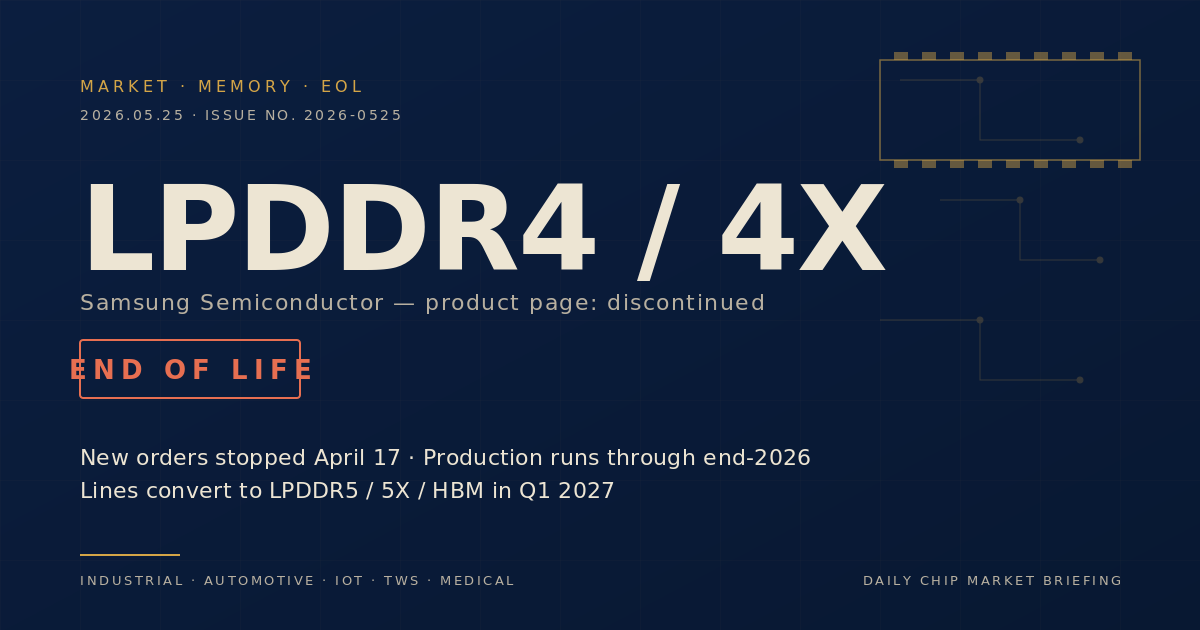
Samsung did this quietly. Both the LPDDR4 and LPDDR4X product pages on Samsung Semiconductor now carry the same notice — "This product has been discontinued." New purchase orders stopped on April 17. Existing committed orders will be produced through the end of 2026. From Q1 2027 the lines fully convert to LPDDR5, LPDDR5X and HBM.
Most of the coverage so far has framed this as a smartphone story. Phones are affected, sure, but phones are not where the real damage lands.
Where it actually hurts
LPDDR4 and 4X sit inside far more than budget phones. Automotive infotainment head units. Telematics modules. TWS earbuds. Industrial gateways. Medical monitors. Ruggedized handhelds. IoT controllers. Single-board computers. A long list of products whose lifecycle is measured in years, not quarters.
A phone gets refreshed every 18 to 24 months. An industrial gateway ships the same hardware for 7 to 10 years. An automotive infotainment platform, once homologated, runs the full vehicle program — typically 8 to 12 years. A class II medical device often needs 10 more years of spare-part support after last shipment.
For all of these, an end-2026 production cliff is not a runway. It is a deadline that quietly arrived in April.
LPDDR5 is not a drop-in replacement
The instinct is "we'll move to LPDDR5." That instinct underestimates the cost.
LPDDR4/4X and LPDDR5/5X differ across three layers that matter for shipping hardware: voltage, signal IO and timing, package and ball-out (physically close in some cases, electrically not always interchangeable). In practice the switch means a board respin, signal integrity revalidation, and PMIC reconfiguration.
For anything under certification — automotive AEC-Q, medical IEC 60601, industrial IEC — a memory swap usually triggers re-qualification. Re-qualification means lab queues, test cycles and paperwork that pause shipments for 6 to 18 months.
This is an engineering project, not a procurement order.
Three things to do this quarter — in parallel
Not in sequence. In parallel.
One — BOM audit within the week. List every program using LPDDR4 / 4X or memory modules containing Samsung die. For each, capture forecast volume through 2030 and the latest date each program needs a confirmed memory source. Sort by which program runs out first.
Two — open LTB conversations now. Samsung's "produced through end-2026 for committed orders" language means allocation is already tightening. Programs filing LTB demand in Q3 2026 will be competing for a shrinking pool. Programs waiting until Q4 are likely to find the pool empty or rationed to top-tier accounts.
Three — scope the LPDDR5 migration honestly. Pull hardware, firmware and qualification teams into one review. Estimate engineering hours, certification fees, and lost shipping time as a dollar figure. For most programs the answer will be "migrate." For some — those late in lifecycle — the correct answer is "don't migrate, LTB enough inventory to reach natural EOL."
Inventory and the secondary channel get more valuable
A side effect worth noting: dormant LPDDR4 inventory is about to look very different.
Once authorized channels are dry, programs that miss the LTB window have two paths — buy whatever SK hynix still produces (the residual primary supplier for the next 12 to 18 months), or source through the secondary channel for legitimate excess stock, brand remainder inventory and discontinued-part sourcing. The second path used to be a cost-saving option. It is becoming a production-continuity necessity.
The catch: secondary channels are fragmented, information is opaque, and quality varies. It needs dedicated sourcing capability and traceability — not a vendor relationship you build the week the line stops.
This is not just a Samsung move
Micron has signaled similar intent across its older mobile DRAM portfolio. SK hynix is still producing LPDDR4X and becomes the residual supplier for the next 12 to 18 months — but treating a last remaining vendor as a permanent fallback is not a strategy.
The structural force is simple. HBM commands four to eight times the ASP of LPDDR. With AI accelerator demand absorbing every wafer leading-edge memory fabs can convert, the economics of keeping legacy LPDDR lines open get worse every quarter. The decision Samsung announced in April is the decision the rest of the industry will make over the next 18 months.
Programs designed in 2020 against a 10-year support assumption now have a 2-year window to choose their next move.