Published on: September 14, 2026
CXMT Maps a Multi-Site DRAM Expansion Toward 600,000–700,000 Monthly Wafers, With Yield and Qualification Still Binding
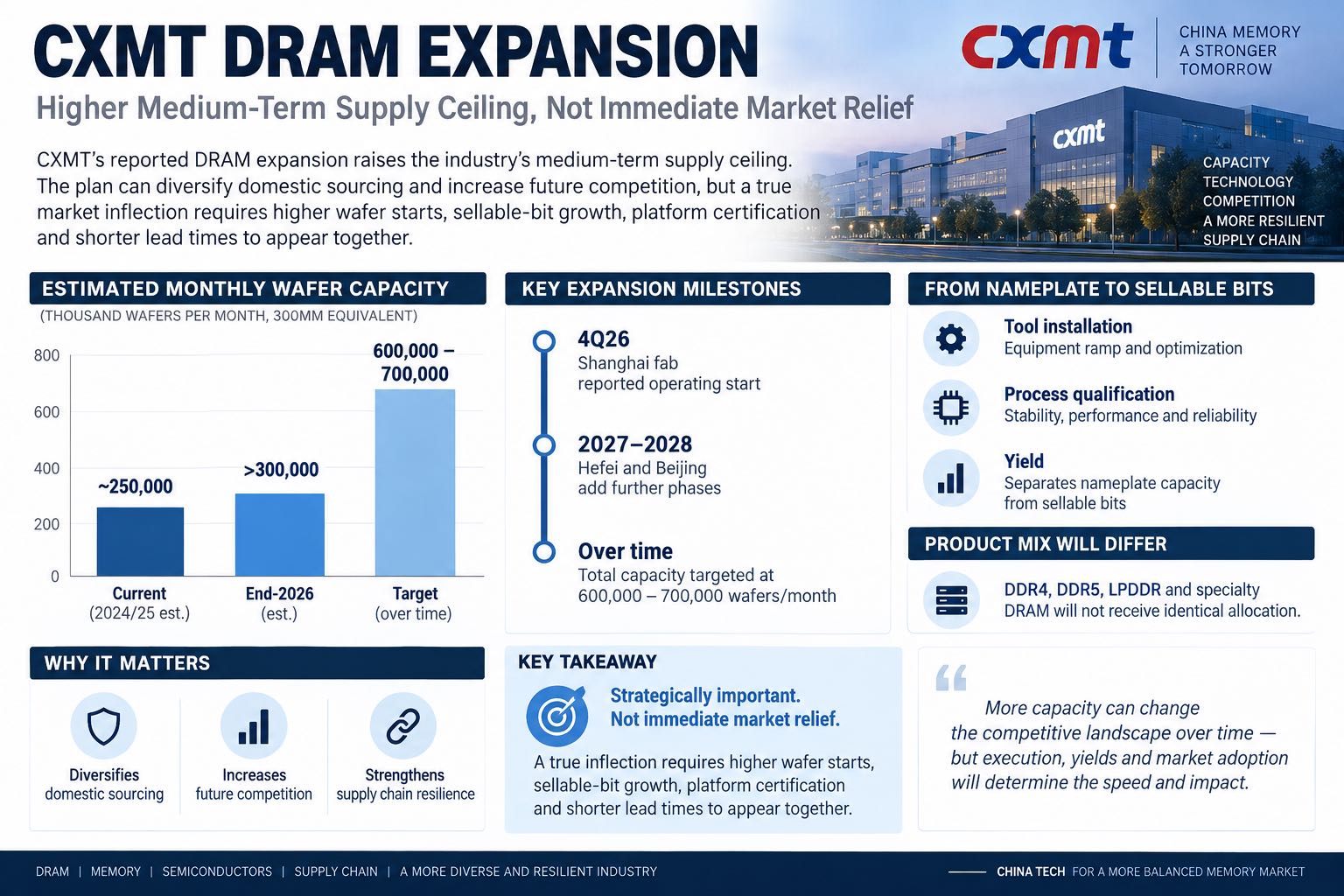
CXMT is reported to be advancing fabs in Shanghai, Hefei and Beijing. Capacity could exceed 300,000 wafers per month by end-2026 and reach 600,000–700,000 over time. Equipment, yields and customer qualification determine when planned wafers become sellable bits.
A multi-site capacity schedule
Reporting published on September 11, 2026 indicates that ChangXin Memory Technologies is moving into equipment bidding for a new Shanghai fab while preparing additional projects in Hefei and Beijing. Current capacity is estimated at roughly 250,000 wafer starts per month, with the installed base potentially exceeding 300,000 by the end of 2026. A longer sequence of projects could lift the total toward 600,000 to 700,000 wafers per month. That upper range is a planning target, not qualified output available to customers today.
The reported schedule places the Shanghai facility in the fourth quarter of 2026, another Hefei phase in the first half of 2027, Beijing in the second half of 2027, and a further Hefei expansion in the first half of 2028. Each step must pass facility completion, tool installation, process qualification, yield ramp and customer approval. Nameplate wafer capacity therefore leads sellable bit output by a material interval.
More cleanroom space does not create immediate relief
DRAM supply is governed by more than floor area. Lithography, etch, deposition, cleaning, metrology and test capacity must arrive in a balanced line, while process integration must produce stable yields. Product mix also matters. Resources assigned to higher-density DDR5 do not automatically solve shortages in legacy DDR4, low-density devices or long-lifecycle industrial grades.
The potential move above 300,000 wafers per month by year-end should be separated from the eventual 600,000-to-700,000 target. The first figure is a near-term ramp marker. The second depends on several sites and multiple years of execution. Tool delays, process conversion or slower yield learning would push bit growth to the right. Faster platform qualification would allow domestic PC, server and consumer customers to diversify supply earlier.
Product mix determines the price effect
DDR4, DDR5, LPDDR and specialty DRAM follow different process, package and validation paths. Aggregate wafer growth can coexist with shortages in selected densities because suppliers optimize revenue, die size and customer commitments. High-value server products may absorb incremental capacity before lower-value spot products receive meaningful allocation.
Public spot data for September 11 showed broadly stable DDR5 quotations and mixed DDR4 movement, with limited trading activity. The pattern does not indicate a uniform price direction. Future CXMT output can reduce concentration, but near-term pricing remains tied to contract allocation, channel inventory, buyer affordability and exact device specifications.
Equipment and qualification are the binding gates
A new DRAM fab requires a complete set of process tools rather than isolated purchases. After installation, engineers must control defect density, capacitor behavior, leakage and cell consistency across a mature production flow. A wafer-start number becomes commercially meaningful only when yields and test pass rates are stable.
Customer qualification adds another interval. PC and server memory must be validated on platforms and modules. Automotive and industrial applications require longer reliability and lifecycle evidence. Observable milestones include sample density coverage, platform approvals, production node disclosure, sellable bit growth and actual lead-time movement. Those indicators provide stronger evidence than announced cleanroom capacity alone.
The longer-term competitive implication
If the multi-site program advances as reported, CXMT would increase China's domestic DRAM scale and narrow the gap with established global suppliers in nameplate wafer capacity. Competition would then depend increasingly on process migration, yield, product mix, customer quality and capital efficiency. The first commercial effect may be greater sourcing diversity for domestic customers, followed by pressure on regional pricing and incumbent portfolio allocation.
The immediate market remains supported by AI-server prioritization and high-end memory demand. A genuine supply inflection requires simultaneous evidence of higher monthly wafer starts, faster sellable-bit growth, mainstream platform certification and shorter lead times. The expansion is therefore a framework for monitoring the fourth quarter of 2026 through 2028, not proof that the current DRAM market has already loosened.
Execution risk remains material. Semiconductor equipment availability, utility commissioning, engineering hiring and intellectual-property constraints can all change the ramp curve. Demand can also shift before new capacity arrives. A slower PC cycle would release some conventional DRAM supply, while stronger AI infrastructure spending could keep industry resources concentrated in server and high-bandwidth products.
The most useful interpretation is structural. A credible new capacity path raises the industry's medium-term supply ceiling and creates another variable in contract negotiations. It does not erase present allocation differences. Market participants will need evidence from production, qualification and shipment data before treating planned wafers as fungible supply.