Published on: August 14, 2026
After AI Drained the Memory Pool: The Mobile DRAM Squeeze Is Killing the Cheap Phone — What Spot Buyers Should Actually Track
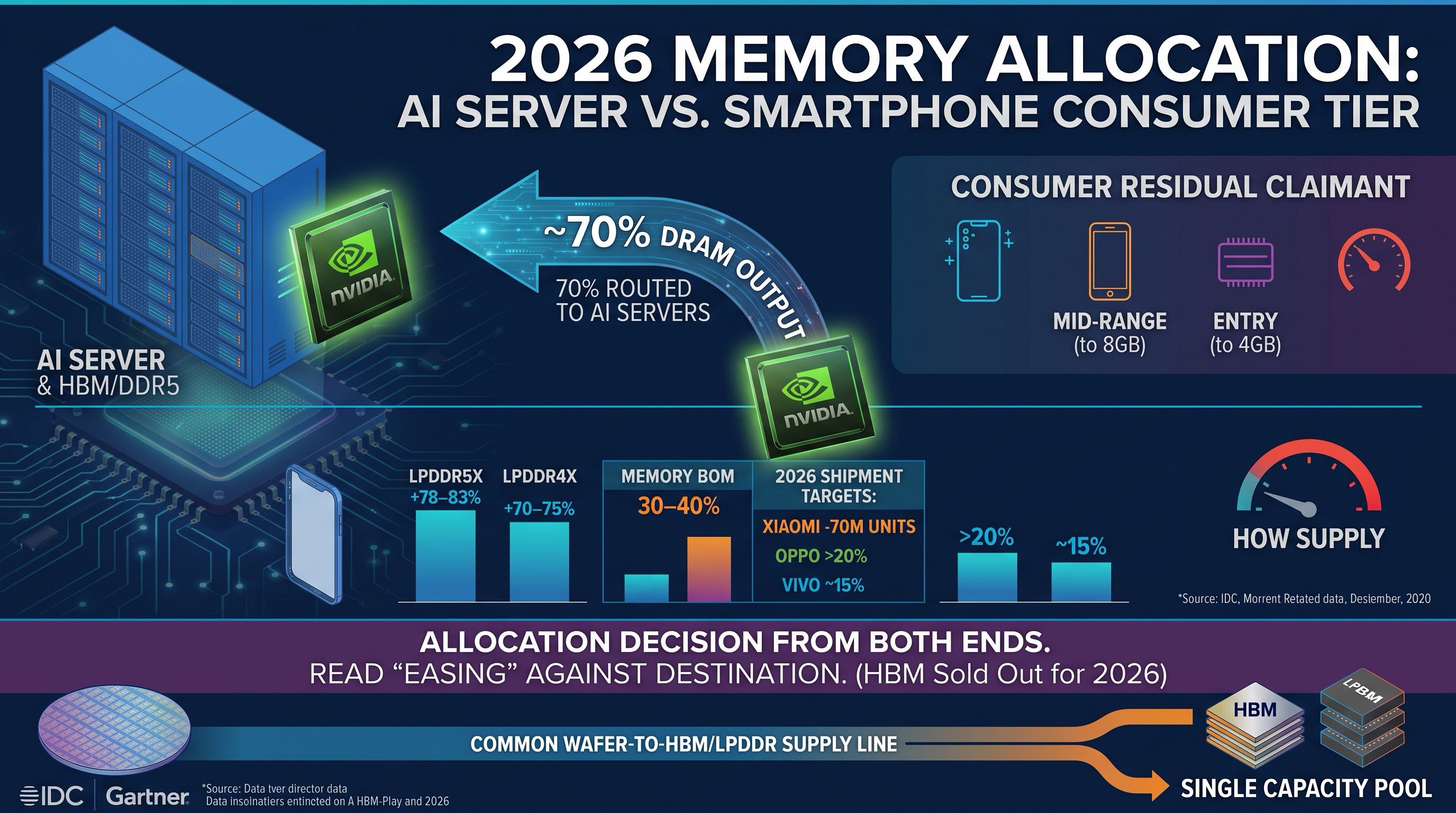
The big three redirected roughly 70% of DRAM output to AI servers, LPDDR5X jumped nearly 80% in a single quarter, and phone makers are cutting orders, downgrading specs, and letting the entry tier collapse. This isn't a consumer-electronics cycle — it's HBM allocation spilling over. For anyone working spot and consumer-grade parts, allocation, quote discipline, and secondary-channel windows now matter more than part selection.
Get the causation straight first — this is not a consumer-electronics downturn.
Rising phone-memory prices, shortages, spec cuts: the root isn't the phone, it's the AI server. HBM, LPDDR, and server DDR5 all come off the same makers and the same DRAM lines. Samsung, SK Hynix, and Micron have pushed roughly 70% of DRAM output toward AI servers. Every wafer that becomes an HBM stack for an NVIDIA GPU is a wafer denied to a mid-range phone's LPDDR5X.
The consumer/mobile tier ends up last in line, structurally.
The numbers, so you have an anchor
- LPDDR5X: up ~78–83% QoQ in Q2; LPDDR4X ~70–75%.
- On a mid-range phone, 8GB of LPDDR5X went from ~$40 to ~$110 in six months.
- Memory's share of a handset BOM climbed from 10–15% to 30–40%.
- Smartphone shipments fell ~11% in Q2 — the worst second quarter since 2013; IDC sees 2026 down 12.9% to ~1.12B units.
OEMs are already acting, not just talking
- Xiaomi trimmed its 2026 shipment target by ~70M units; OPPO cut >20%, Vivo ~15%.
- Spec downgrades are now standard: flagships retreat 16GB→12GB, mid-range to 8GB, entry converging on 4GB — even the Pixel 11 is reported to ship with less RAM.
- The sub-$100 tier takes the worst of it; memory eats too much of the build cost, and that price band is effectively being erased.
Why should a spot buyer care? Three things
1. Stop quoting consumer-grade memory on spot terms. LPDDR, eMMC, and consumer DDR are constrained parts now, not casual refills. The big three prioritize AI servers; the consumer tier takes whatever allocation is left. If you carry a consumer BOM, isolate the memory line and size the exposure separately — don't run it on the same spot logic as everything else.
2. Price allocation risk and escalation into every quote. The problem isn't just "expensive" — it's "can I get it, and when." On consumer orders, keep quote windows short and write lead-time uncertainty and escalation clauses in. Don't commit an old price and old lead time on something that ships in three months; that delta and delay land on you.
3. Watch the short-lived secondary windows from OEM cancellations. There's a counter-intuitive opening here: as phone makers cut orders and downgrade specs, consumer memory/modules that were locked to them get flushed into the secondary channel, forming brief inventory pockets. These windows open and close fast — take them when they appear, but don't chase the top. It's mismatch-driven stock, not a trend reversal.
One signal not to misread
Q3 server-DRAM contract gains narrowed to +13–18% (Q1 was +81%). Some will call that "memory is easing." It isn't. The narrowing is a high base plus softening consumer demand; physically, HBM and server DDR5 stay tight and single-direction up. A smaller increment is not a price turn. The consumer squeeze is itself the other side of "all the capacity went to servers."
To close: this isn't phones falling apart — it's memory drained by AI, with the consumer tier last in line. Reading who's fighting for capacity beats reading handset shipment counts.