Published on: July 31, 2026
NAND Just Repriced Harder Than DRAM — Why Enterprise SSD Is the Squeeze Spot Buyers Keep Missing
Everyone's watching HBM and server DRAM, but Samsung's own Q2 call laid the numbers bare: NAND ASP rose ~60% QoQ this quarter versus DRAM's ~40%. NAND is the half that climbed harder. Enterprise SSD has quietly become the largest NAND application, locked to cloud LTAs into 2027. Here's the split — enterprise locked, consumer soft — and a working checklist for spot buyers.
For two months the attention has gone to HBM and server DRAM. Fair enough — but that's exactly why NAND got quietly under-read.
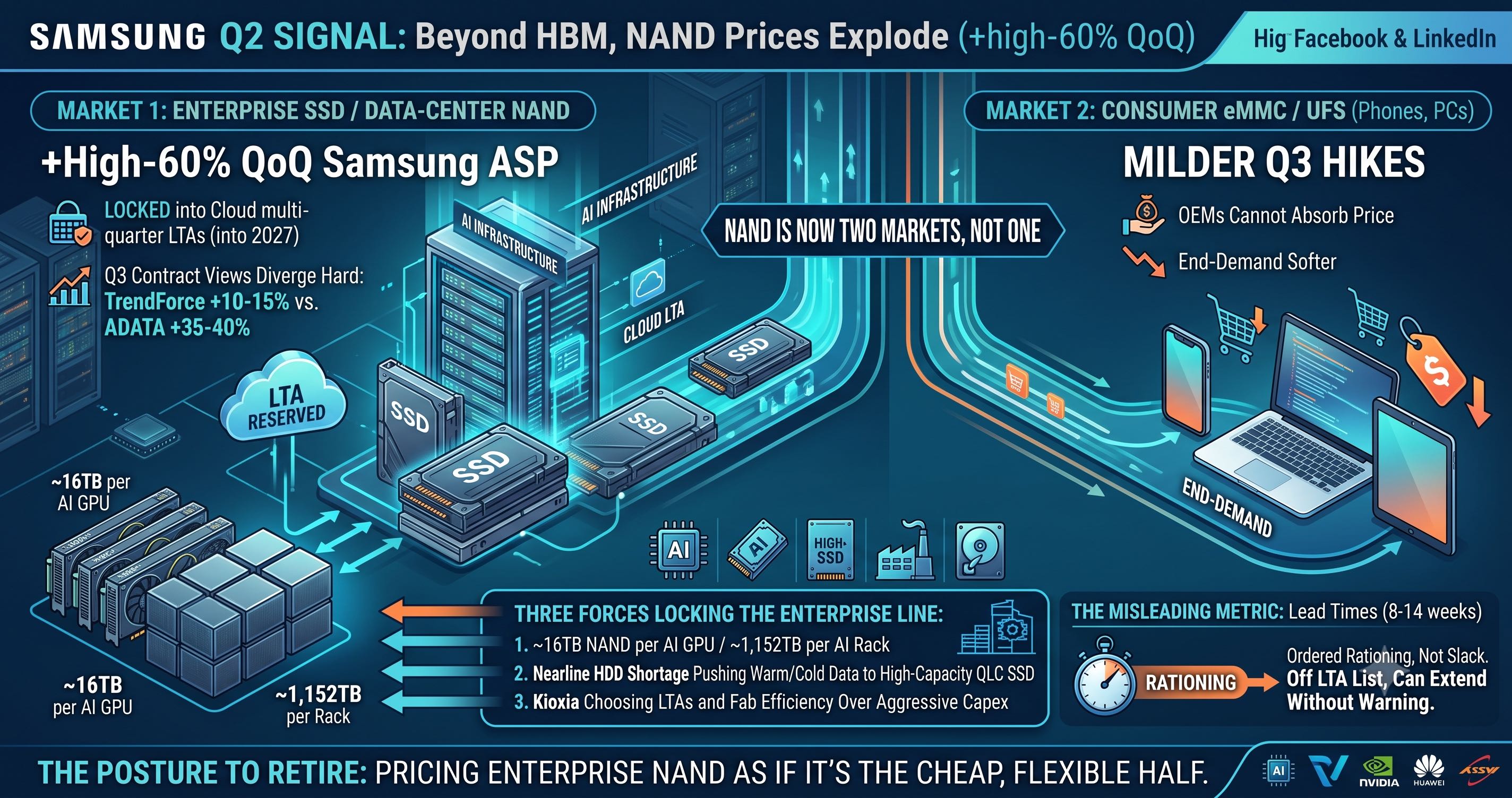
On its 07-30 Q2 call, Samsung broke out its own ASPs: DRAM average selling price rose ~40% QoQ (mid-40%); NAND rose ~60% QoQ (high-60%). Blunt as that — NAND repriced harder than DRAM.
The trouble is that a lot of quotes still treat NAND as the "cheap half" out of habit. That assumption expired this quarter.
Split one book into two
NAND isn't one line anymore. It's two lines pulling apart. Stop pricing them off a single sheet.
- Enterprise SSD / data-center NAND — the locked line. Enterprise SSD is now the single largest NAND application, past client SSD and phones. Capacity is locked to AI/cloud multi-quarter LTAs into 2027. Q3 contract views diverge hard: TrendForce says +10
15%, but ADATA's chairman cites supplier notices of +3540%. Quote enterprise parts at the +35~40% risk ceiling, not the moderating band. - Consumer eMMC / UFS — the soft line. Q3 eMMC/UFS hikes are visibly milder because OEMs can't absorb price and end-demand is softer, so supplier pricing power weakens here. This line can be worked on short spot terms.
One sentence: same word, two worlds. When a buyer waves "even NAND has gone soft" at your enterprise SSD quote, that's a bait-and-switch — push it back.
Why enterprise is this locked
- A single high-end AI GPU needs ~16TB of TLC/QLC NAND; a standard AI rack an estimated ~1,152TB. That's the main course, not a garnish.
- Nearline HDD is short too, pushing warm/cold data that used to sit on disk onto high-capacity QLC SSD — another wave of enterprise NAND demand.
- Suppliers are holding capex. Kioxia is explicit: LTAs, BiCS migration and fab efficiency over aggressive expansion. Supply isn't opening up — same logic as the "margins too good, zero incentive to cut" story on the DRAM/HBM side.
"Shortest lead time" ≠ "loose"
Enterprise SSD lead times of 8–14 weeks are indeed the shortest among core parts. Don't be fooled by the number — it's short because allocation is orderly, not because supply is loose. If you're not on the LTA list, that 8–14 weeks can flip. Short lead time plus hard allocation is the most misread combination on this board.
Spot-buyer checklist
- Enterprise SSD / data-center NAND: quote at the +35~40% risk ceiling, 24–48h validity.
- Split consumer eMMC/UFS (soft) and enterprise SSD (locked) into two separate price books — literally separate lines on the quote so buyers can't blend them.
- Stop pricing enterprise parts off the "NAND is cheap" assumption — the supplier's own numbers just inverted it.
- QLC / high-capacity is where the AI pull concentrates; on BOMs carrying high-cap enterprise SSD, flag locking volume, not locking a low term price.
- On projects with nearline storage, remind downstream that HDD shortage is spilling into QLC SSD — the demand only hardens.
Closing read
The signal most likely to slip past you this quarter isn't another "record" headline — it's the supplier putting NAND's increase ahead of DRAM's, in its own words. The market's still crowded around the HBM table. The NAND table quietly changed the menu. Whoever quotes off the new menu first eats fewer surprises.