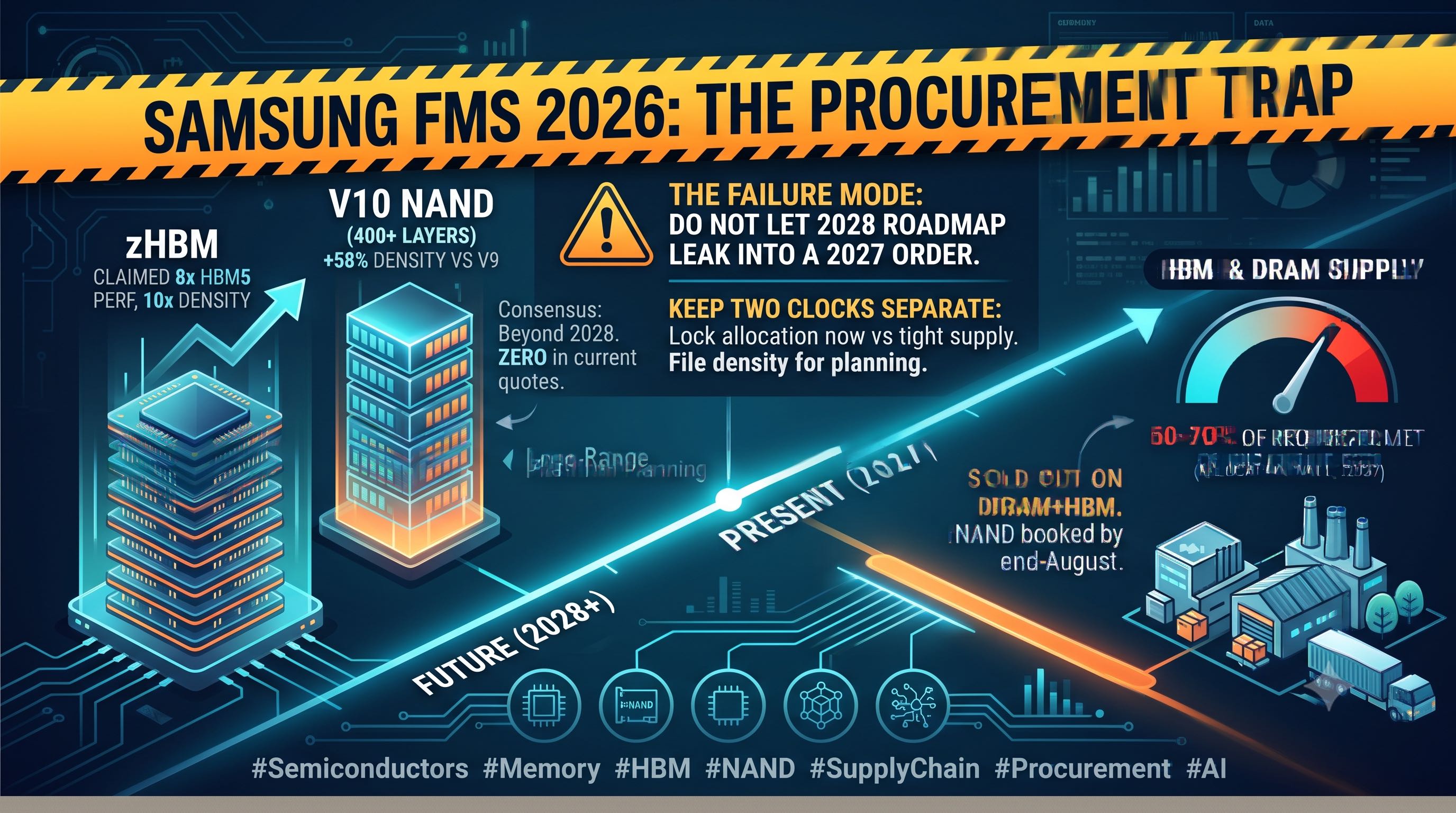
Published on: August 7, 2026
Samsung Just Dropped zHBM and 400-Layer V10 NAND at FMS 2026 — None of It Fixes Your 2027 Allocation
At FMS 2026 Samsung unveiled a zHBM concept (claimed 8x HBM5) and the industry-first 400+ layer V10 NAND (+58% density). The specs are loud. The one line spot buyers need: it's all post-2028, and it does nothing for the 2027 allocation wall. Here's how to read a roadmap without letting density numbers set your pace.
At FMS 2026 (Santa Clara, 8/4) Samsung put its next-gen memory roadmap on the table, and it came with plenty of headline bait:
- zHBM — 3D-stacked, memory sitting directly on top of the GPU, claimed 8x HBM5 performance, >10x density, 3x energy efficiency, thermal resistance halved.
- Industry-first 400+ layer V10 BV-NAND — +58% density over V9, built on wafer bonding.
- Plus zNAND-O and HBM4E (sampling since May).
Great numbers. But if you're on the spot desk and your question is "can I get parts this month," park the excitement first.
Separate the two things: this is a roadmap, not inventory
zHBM still has no production timeline. The consensus read is that it lands only after HBM5 actually ramps — realistically beyond 2028. Every quote you negotiate this year and next has exactly zero zHBM in it.
V10 NAND's +58% density is a real process step, but it still has to clear qualification, tooling, and yield ramp. +58% density does NOT mean +58% supply next year. What it moves is where the unit-cost curve bends after 2028 — not your 2027 build plan.
Why nail this down now
Because the market is running on the "2027 DRAM+HBM fully booked" narrative — the big three's 2027 capacity is sold, buyers get only 60–70% of requests, NAND expected fully booked by end-August. That's a structural allocation wall.
Drop an "8x performance, +58% density" roadmap into that moment and it's easy to misread as "relief is coming." It isn't. Next-gen density can't rescue 2027 — that year's wafers are already allocated, and a new node can't ramp in time. Loosen your grip on locking allocation because a roadmap looked shiny, and you likely won't make the 2027 queue.
The spot-buyer read
- On high-2027-volume parts, keep locking allocation and negotiating LTAs against today's tight supply. Don't wait for a new node to backfill or cut price.
- On near-term tight parts (DDR4/DDR5 spot, enterprise SSD/QLC), keep short orders, lock quantity, run 24–48h quote windows. DDR4 spot is still inverted above HBM3e this week — no reversal.
- File the roadmap under 2028+ product planning. The V10 NAND density step is genuinely useful for future high-capacity SSD cost calls — but that's a next-next-year ledger.
One line to keep it honest: a spec keynote is written for capital markets and product managers; the allocation queue is written for procurement. The two clocks aren't on the same scale — don't hold up a 2028 roadmap against a 2027 order.